

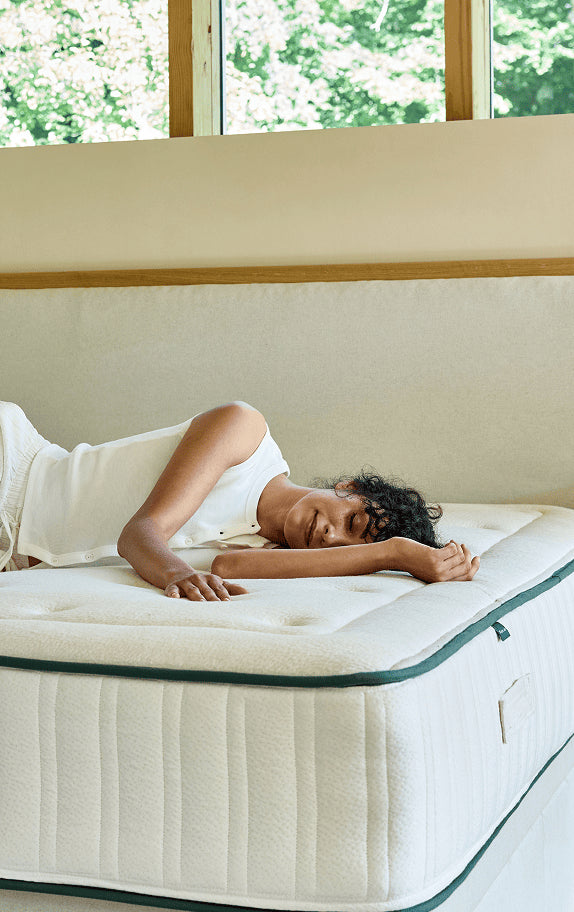
You don’t change your mattress every day. So, naturally, when you settle in for your first night on a new one, the experience can be surprising. It often takes a little time—on average, 7 to 10 days—for the body to adjust to this new balance. And this adjustment period can be longer if you’re switching from a very worn-out mattress, to which your back had, for better or worse, become accustomed.
But what we sometimes forget is that a mattress, too, changes over time. It loosens up slightly, becomes softer in certain areas, and conforms more naturally to pressure points. With natural materials like latex, this transformation is gradual and organic, without any sudden sagging or discomfort.
This is neither a defect nor a sign of premature wear. On the contrary: it’s proof that your mattress is adapting to you, gradually conforming to your body shape at your own pace.
Comfort That Lasts Over Time
Unlike synthetic foams—which often sag suddenly, creating pronounced dips or a sudden loss of support—natural latex has this valuable quality: it adjusts gently over time. In the first few days, it may feel a little firmer, especially if you’re used to a mattress that’s too soft or sagging. Then, gradually, it gives way where it needs to, without ever compromising your spinal alignment.
This process is often imperceptible, but it plays a fundamental role in providing lasting comfort. A Kipli mattress doesn’t try to “impose” itself—it adapts. And it is these subtle adjustments that make the difference between artificial comfort and genuine, real comfort.
The Natural Life Cycle of a Kipli Mattress

A Kipli mattress is built to last. Its core, made of certified, chemical-free natural latex, is both resilient and breathable. It doesn’t sag like conventional foam: it softens slightly over time while retaining its elasticity and support.
Here's what to expect over the coming months:
After 10 to 15 days: Your body begins to adjust, and your sleep patterns stabilize.
After a few weeks: the latex softens slightly at pressure points (shoulders, hips) and conforms more naturally to your body.
After a few months: the mattress settles into its final shape. It retains its support but offers a softer, more familiar feel.
Over the long term (several years): The mattress ages slowly, without significant sagging. It retains its shape, provided it is properly cared for.
These changes are normal. They are even desirable: they are a sign of regular use and of a living material that does not deteriorate but adapts.
Healthy longevity, not set in stone
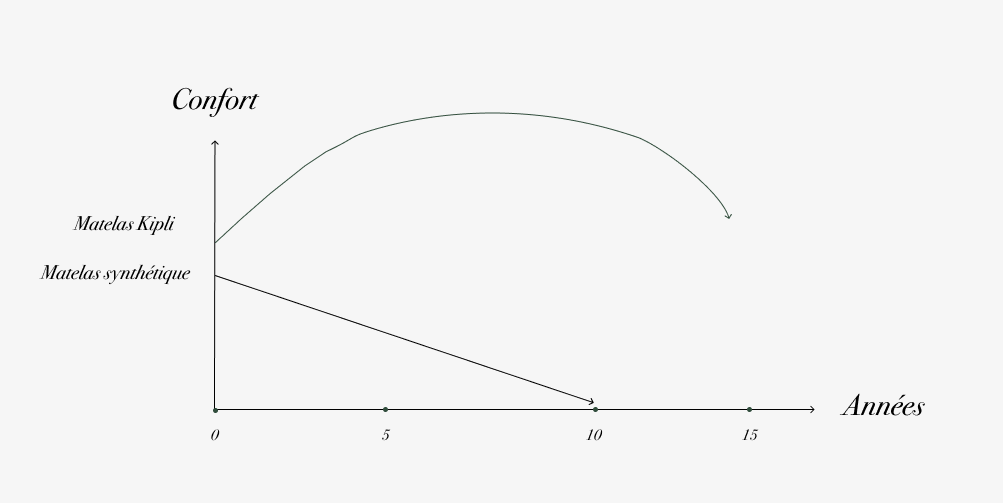
Wanting a mattress that never changes is sometimes like dreaming of an item that stays “like new.” But this myth doesn’t hold up to the test of real sleep. Because what we call “new” is often synonymous with “not yet adapted.” The right mattress is one that becomes more and more comfortable over time—one that conforms to your body without losing its shape, and one that supports you without ever feeling restrictive.
It is this gradual evolution that ensures a healthy lifespan. And it is also what distinguishes a natural product—designed to last—from a mass-produced mattress intended to be replaced after a few years.
How can you keep up with the changes in your mattress?
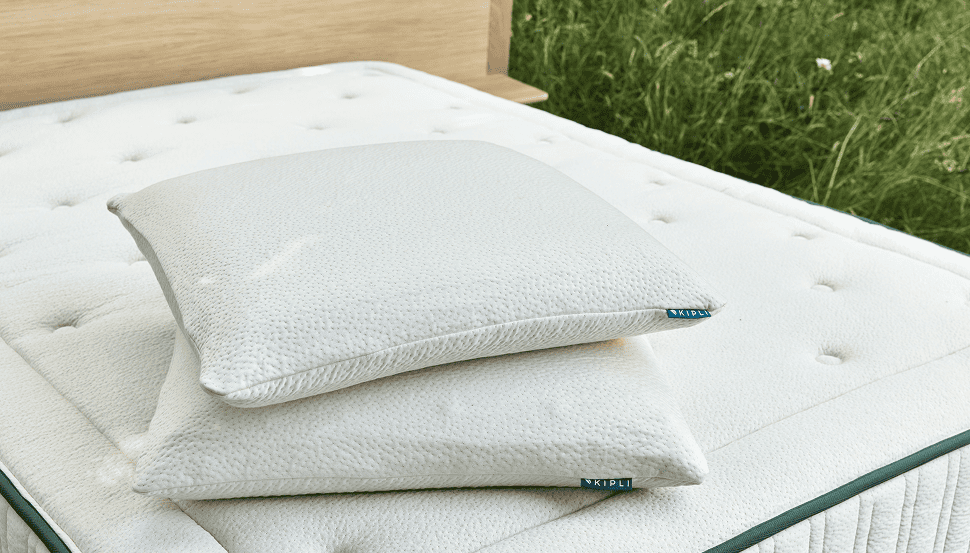
A few simple steps can help support this natural process and maintain comfort over time:
Flip the mattress regularly during the first 6 months (head to toe), and then every 3 to 6 months.
Air out the bedroom and the mattress to maintain good breathability.
Use a suitable box spring—with fixed or flexible slats—that provides even support for the mattress.
Choose bedding that fits well (mattress protectors, sheets made from natural materials) to protect the surface without compromising comfort.
A mattress that changes a little is a good sign
What you’re feeling isn’t a flaw—it’s a dialogue. Between your body and the mattress. Between the nights you’ve had and the nights to come. It’s the hallmark of a living comfort—one that isn’t imposed, but is created together.
So if, after a few weeks, you feel that your mattress has changed… that’s a good thing. It’s proof that it’s built to last and to be there for you. Night after night.