

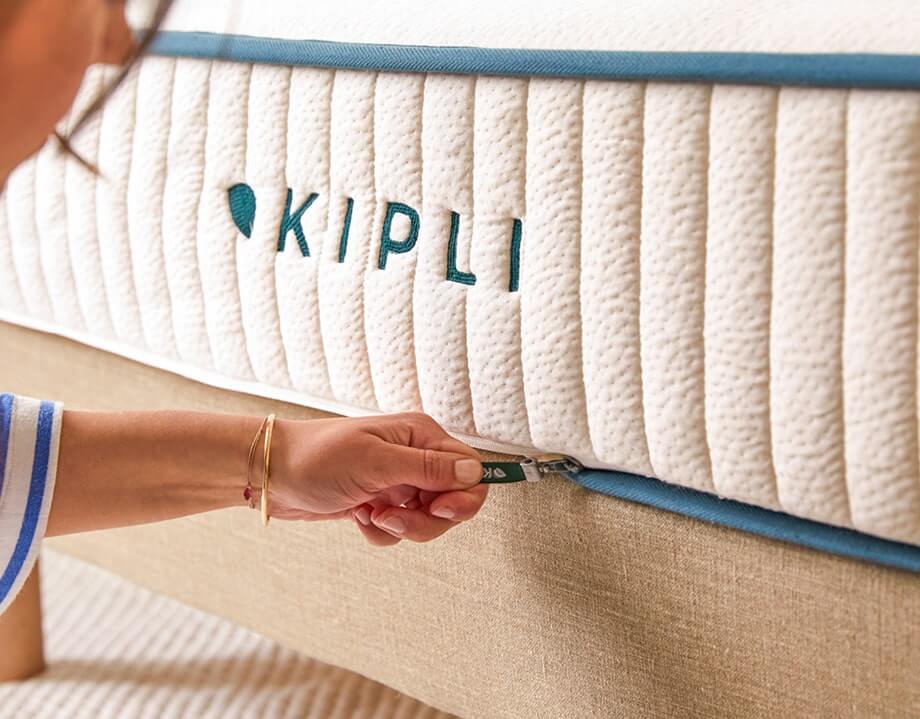
Not all covers are the same
A mattress cover is an important item— not just a decorative accessory. Covers may seem similar, indistinguishable, or simply more or less aesthetically pleasing. But there are many quality aspects of a cover that you should consider to make an informed choice when buying your mattress, which will help you understand the value for money of the different mattresses you’re comparing.
We wrote this article following the development of our mattress cover, for which we examined every aspect—from the fabric to the manufacturing process, including the design and filling. During this process, we met with everyone involved in creating the mattress cover to ensure that we could make the most informed choices ourselves for each component. Here, we’re sharing our checklist, which will surely help you make the best purchase, and then we’ll tell you the story and the journey that led us to design the current Kipli mattress cover.
An 8-month journey in partnership with Europe’s leading fabric and cover manufacturers. In light of the current environmental and climate crisis, we believe that our consumer choices must take into account at least three fundamental aspects:
- People's Health and Well-Being
- Ecology and Respect for the Planet
- A fair price that takes negative externalities into account. These are the three core principles of our checklist. If these principles do not align with the values that guide your purchasing decisions, our checklist will not be right for you.

0% PLASTIC FIBER
Polyester is a synthetic material derived from plastic that is widely used in the textile industry for its properties and affordability. Its main characteristics are:
- Elasticity and Resilience (the ability to return to its original shape after being compressed)
- Resistance to moisture and chemicals
- Mechanical Strength
- Washable at almost any temperature
- A low thermal conductivity coefficient (it is a material that retains heat).
Despite its undeniably appealing properties and the fact that polyester is used in most fabrics and the vast majority of mattress covers, we decided not to use it at all. Its properties actually conflict with the two values that underpin our checklist. From a health and well-being perspective, polyester contains a number of chemical compounds that can have negative effects, particularly when exposed to heat.
Polyester also traps heat and does not allow for ideal thermoregulation, causing a feeling of warmth at night, leading to sweating and reducing sleep comfort. In addition, when polyester is exposed to body heat, it can release some of the chemicals it contains, which can be inhaled or absorbed through the skin.
In some cases, when polyester is "thermally bonded" with other natural fibers, it is treated with a substance called formaldehyde, which, according to EU classification, is considered a Class 3 carcinogen and is subject to very strict regulations in Europe but not in other countries—from which, for example, polyester may be imported.
From a health perspective, polyester can also cause allergies, according to a study by the European Commission, which you can find at this link. This study shows that 7 to 8 percent of skin conditions are caused by our skin coming into contact with the fabrics we wear. Polyester is among the causes of allergies identified in this study.
From an environmental perspective, the main problem with polyester is its end-of-life (a strand of polyester takes between 30 and 350 years to decompose).In addition, fossil fuels are used in its production, and their environmental impact is well known. Its production is also particularly energy-intensive (125 megajoules per kilogram of fiber, compared to 12 for organic cotton).
Polyester is found in most linings on the market, and many brands come up with fanciful names to avoid mentioning it. Among the most common terms, you’ll find “batting,” “microfiber,” and “stretch.” Often, only the fabric is described, not the filling—which, in most cases, is made of polyester (often called “wadding”) and is frequently thermally bonded to natural fibers.
Polyester is also a major source of water pollution. In fact, these synthetic materials release plastic microfibers every time they are washed… According to ADEME, 500,000 metric tons of plastic microparticles are released into the world’s oceans each year as a result. For example, 90% of the microplastics found on Sweden’s coastlines consisted of synthetic textile fibers.
NO FLAME RETARDANTS
Flame retardants are chemical agents used in treatments to make certain materials and objects nonflammable or less flammable. These agents are used in many mattresses, primarily to reduce the flammability of textiles or foams such as polyester or polyurethane.
These chemical compounds, which are used in most mattresses today, can be toxic. We designed our cover to have natural flame-retardant properties and to require no chemical treatment.
One alternative to using these chemicals is to use wool as the filling, which has excellent flame-retardant properties.

100% NATURAL MATERIALS
We use only natural materials in the construction of the cover and its filling. The reasons for this choice stem from the fact that natural materials offer very beneficial properties when used in bedding textiles. Specifically:
- High breathability
- Free of toxic substances and chemical treatments (see the choices we made in the section titled "The Story of Our Cover")
- Biodegradable materials
- RenewableMaterials : Theirproduction requires less energy than that of synthetic materials, for example (125 megajoules per kilogram of fiber for polyester, compared to 12 for organic cotton). These materials have a very pleasant and soothing feel against the skin. Natural materials do not have the same properties.To learn more, please continue reading the following paragraphs.
EASE OF USE AND MAINTENANCE
Another factor to consider is the presence of handles. They are important for moving the mattress and flipping it periodically. Ideally, there should be four handles on the longest sides of the cover so that two people can easily move the mattress.
When it comes to maintenance, to maximize the cover’s durability, it’s important that it be washable. This isn’t possible if the cover doesn’t have a zipper and isn’t unlined. We recommend choosing a removable cover with a zipper on all four sides, so that the top panel can be removed for cleaning without having to move the mattress.
Generally speaking, for most covers, we recommend dry cleaning—especially to avoid drying issues that, if not handled properly, can lead to problems such as mold growth or shrinkage of the cover.
WHERE THE MATERIALS AND FABRIC ARE MANUFACTURED
Another factor to consider is where the cover is manufactured and where the fabrics, threads, and accessories are produced. The creation of an upholstered cover takes place in a factory, which is called a "manufacturing" plant.
The panels and strips are manufactured at the factory, where they are then assembled with hardware to create the finished upholstery. However, the fabrics, sewing thread, and filling material are, in most cases, not produced at the factory but elsewhere. It is important to verify the origin of the raw materials, fabrics, threads, and filling material. These components are often certified, and the manufacturer must be able to verify the origin of the materials and the supplier. The“made in” label therefore refers only to the place of manufacture—or, in some cases, merely assembly —and not to the origin of the materials. That is why you shouldn’t stop at the phrase“made in France”; it’s a good idea to inquire about the origin of the materials used.

CERTIFICATIONS FOR TEXTILES AND TEXTILE COMPONENTS
In the textile industry, there are many types of material certifications, and it would take too long to list them all. In our checklist, we have emphasized the importance of choosing natural, rather than synthetic, materials.
THE PRICE
The price of a filling of the same weight is twice as high for wool as it is for polyester. But to achieve the same loft as polyester, you need to use about twice as much wool. The price of a wool filling is therefore ultimately four times higher than that of a polyester filling.The problem is that when we talk about price, we use the nominal price as a reference. This is a mistake we risk making every day in our consumer choices, and it leads us to logically incorrect conclusions. A small example is worth a thousand explanations. Let’s imagine we have to compare two cans of tomatoes. The first is produced in China, the second in Italy. The tomatoes used are the same, as is the packaging. In the Italian supermarket, the can produced in China costs 10% less than the can produced in Italy. The nominal price of the Chinese can of tomatoes is therefore lower than that of the can produced in Italy.
That is how we usually compare prices. But there is a problem. Comparing two nominal prices makes no sense and is illogical. The nominal price does not take into account what are known in economics as negative externalities. Negative externalities are the social and environmental costs that the entire community and future generations will have to bear, and which are never included in the nominal price.

In the example of the box of tomatoes, shipping the box from China, for example, caused CO2 emissions that will contribute to climate change. If the cost of these emissions were included in the nominal price, the two boxes would likely cost the same, or the box of Chinese tomatoes would be more expensive than the one produced in Italy. The same is true for any good. We’re comparing two numbers, two prices. But nominal prices contain only a partial truth—they contain a lie. Nominal prices are a scam at the expense of future generations and the planet. A mattress with a polyurethane or memory foam core and a cover made of polyester or polyester fibers blended with natural fibers costs one-fourth as much to produce as a mattress with a natural latex core and a cover made of natural fibers. Now, if we take negative externalities into account, which one would be more expensive? Have the consequences for your well-being and health been included in the nominal price? Have disposal costs been factored in?The answer is no.
We hope you enjoyed this article and that it gave you a good overview of the key features of the mattress cover. We also invite you to read our article on the history of Kipli—specifically, the history of the Kipli mattress, from its family heritage to its current production.
See you soon
The Kipli Team