

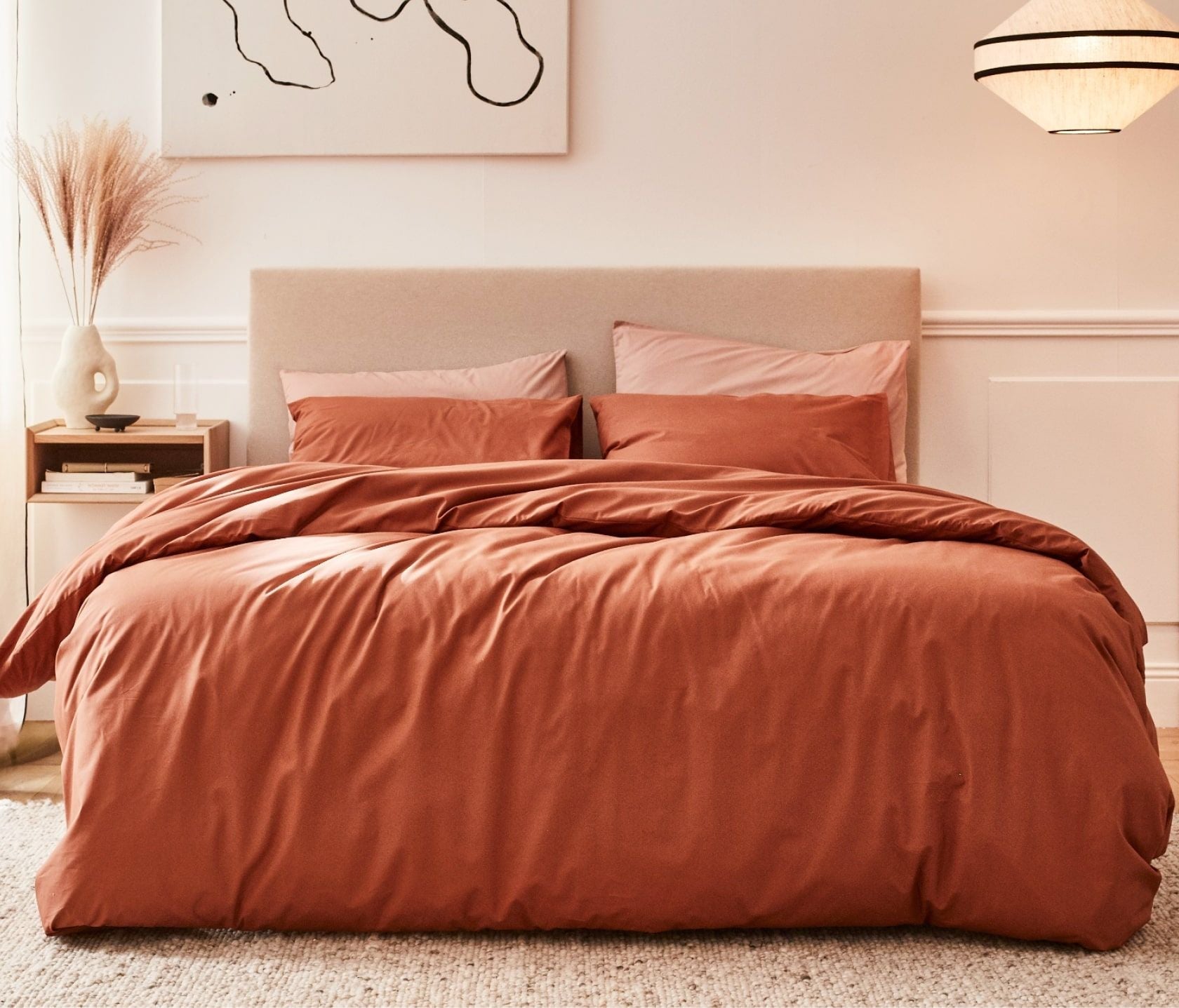
We spend more than a third of our lives in bed, and we all hope to enjoy a good night’s sleep there. That’s why choosing the right bedding is essential for getting the best possible sleep. Cotton twill, cotton percale, cotton satin… How do you know which one to choose? Here’s a quick guide to help you choose the right bedding for your needs.
-
Cotton fabric
Cotton fabric made from plant fibers is the most commonly used material in the manufacture of bedding. It is the most standard quality, which is inferior to that of percale or cotton sateen. As for the weave, the higher the thread count, the better the quality. Cotton plain weave has a thread count of 57 threads per square centimeter. It is not recommended to choose cotton plain weave bedding with a lower thread count, as the quality will be too low. Cotton plain weave is not very supple and is preferred by those looking for a somewhat stiff fabric. Its lifespan varies: high-quality cotton plain weave can last for several years.
If you're looking for high-quality bedding, it's best to choose percale or cotton sateen.Cotton percale and cotton sateen are two fabrics made from high-quality cotton. They differ mainly in their weaving techniques.

-
Cotton percale
Cotton percale is made using a traditional weave that is of higher quality than plain-weave cotton. This weave involves passing each thread over and then under, both horizontally and vertically. This technique gives the bedding a matte finish and makes it softer than plain-weave cotton. Naturally breathable, it feels light and is suitable for all seasons.Furthermore, thanks to its tight weave, cotton percale is durable over time. Cotton percale is also easier to care for than plain cotton fabric: machine washing makes the cotton even softer over time.Kipli offers natural, high-quality bedding sets made from cotton percale woven at 80 threads per square centimeter.
-
Cotton satin
Cotton satin is made using a specific weaving technique. Specifically, the threads pass over three times and under once, both horizontally and vertically. This process gives cotton satin its lustrous, satiny sheen, which resembles that of silk.Cotton satin bedding is heavier and retains heat better. Unlike cotton percale, cotton satin is less breathable and less suitable for people who sweat at night. If you’re looking for a more luxurious look, cotton satin will suit you better. However, it doesn’t last as long as cotton percale.
Choose certified natural products!
Because it comes into direct contact with our bodies, we believe that bedding should be completely natural and healthy. Choose bedding made from OEKO-TEX® STANDARD 100-certified cotton. This means the bedding is free of harmful substances.
Other materials that are just as pleasant
In addition to cotton, there are other comfortable materials to help you sleep soundly at night.If you’re looking for more luxurious bedding with a lustrous sheen, silk is a great choice. It’s a natural material made from the cocoons spun by silkworms. Its quality is measured in mommes (mm), and for high-quality bedding, we recommend choosing silk with a minimum of 19 mm.
Thanks to its natural properties, silk bedding absorbs and wicks away the moisture your body produces overnight. Tencel (or lyocell), which is less expensive , is a fabric that feels similar to silk to the touch.
Lyocell is a natural material derived from wood pulp. Its cultivation requires no harmful chemicals and very little water; it is therefore a material with a very low environmental impact. This fabric is naturally hypoallergenic, strong, and durable. Its properties allow it to regulate body temperature and absorb moisture. Although not commonly used for bedding, linen is also a natural and durable material.
Flax is an eco-friendly plant; it requires no chemicals or large amounts of water, and produces no waste because every part of the plant is used to make this fabric. This bed linens, which are durable and naturally dust-mite-resistant, can also be Oeko-Tex certified.
We hope you enjoyed this article!
Of course,
The Kipli Team