

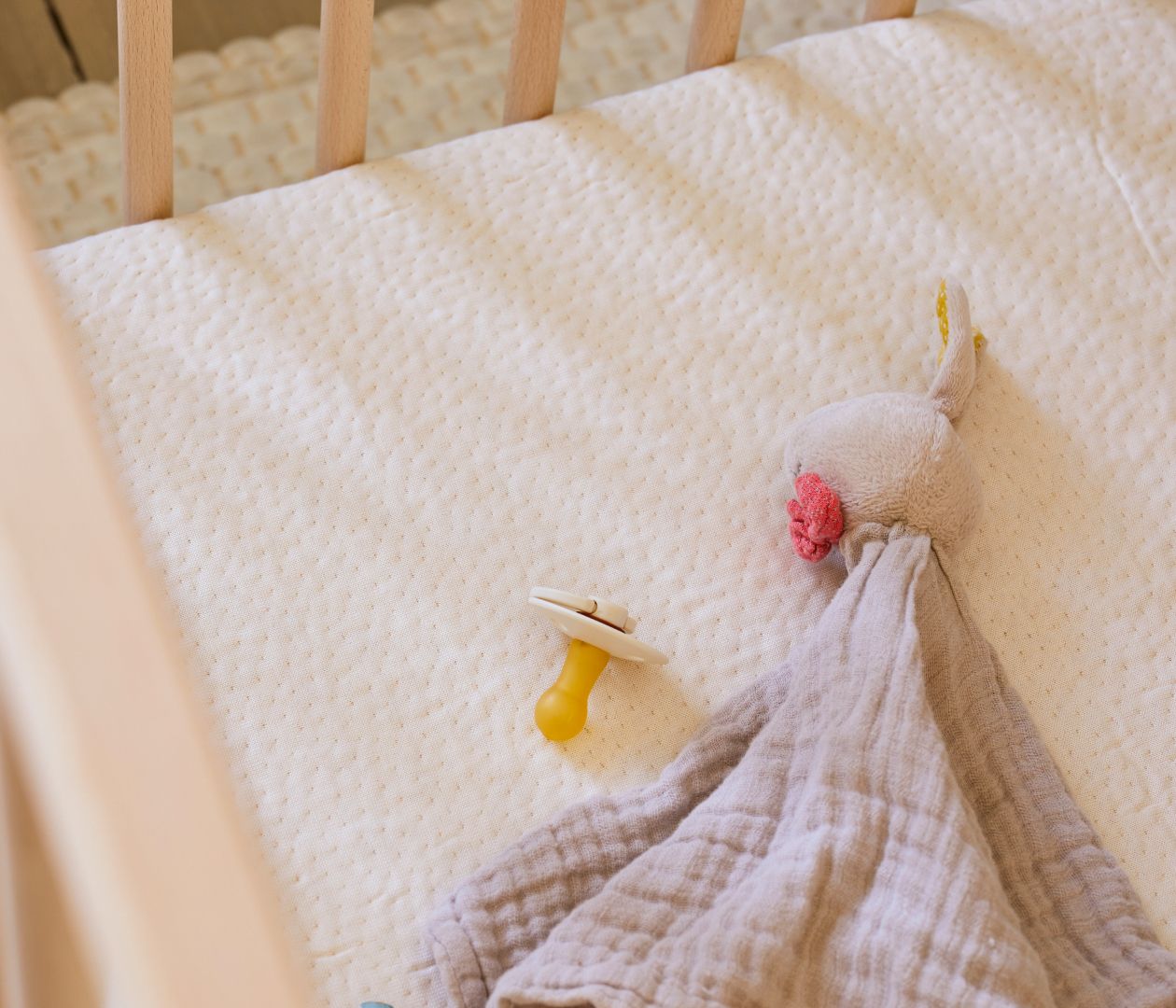
With the happy event just around the corner, there are plenty of preparations ahead of you. You’ve probably already thought about the crib, the mattress, and the sleep sack. But have you thought about a mattress protector? Leaking diapers, spit-up, and sweat—your baby can really put a strain on their mattress. How do you choose a mattress protector that will protect their bedding while ensuring the best comfort? Flat sheet style, fitted sheet style, polyurethane, cotton. Are you feeling overwhelmed by all the options available to you? Don’t panic—we’ll walk you through everything you need to know to choose the mattress protector that will help your child enjoy peaceful nights.

Why use a mattress protector for a baby?
The mattress protector serves two main purposes: to protect the baby and to protect the mattress.
Sleep is essential for newborns; it’s when they process everything they’ve learned throughout the day. Since they’ll be spending long hours in their bed, it needs to be a truly cozy cocoon. By absorbing urine leaks, the mattress protector will prevent your child from being in prolonged contact with large amounts of liquid. Absorbing moisture will also help prevent the growth of bacteria. A mattress protector tailored to your baby’s needs will thus contribute to the quality of their sleep.
As the name suggests, a mattress protector will also shield your mattress from any minor mishaps your baby might cause while sleeping. It acts as a protective barrier that keeps moisture from reaching the mattress cover. Washing a mattress isn’t easy, and it renders it unusable for a while. The mattress protector saves you from this chore. It’s an essential accessory for maintaining a clean sleeping environment while making your life easier.
What size mattress protector should I choose?
The first factor to consider when choosing amattress protector for your baby is size. Do you plan to have your child sleep in a bassinet during the first few months of life? You might be tempted to choose a larger mattress protector in anticipation of the transition to a crib, which typically happens between 6 and 9 months. We don’t recommend this. If the mattress protector is too large, it may shift and create uncomfortable creases against your baby’s back. Since your baby’s sleep is delicate, even the slightest discomfort can wake them up.
The mattress protector shouldn't be too small either. With all the movement your child makes at night, it will shift around under the fitted sheet. Goodbye comfort and protection!
The mattress protector must therefore fit the bed perfectly:
- 30 x 70 cm or 40 x 80 cm for bassinets and cribs,
- 60 x 120 cm or 70 x 140 cm for cribs and travel cribs.
Finally, the edges should be slightly wider than the thickness of the mattress to ensure a secure fit.
The Different Types of Baby Mattress Protectors
There are several types of mattress protectors. Let's see which one best meets your needs.
-
Plateau
This model covers only the top of the mattress. It attaches at the four corners with elastic bands. Although it is easy to install, it does have several drawbacks.
- First, it doesn't protect the sides of the bed. If, like many newborns, your baby likes to press up against the sides of their crib, their mattress will be at the mercy of any little leaks or spit-ups.
- If it's attached more loosely, it may have a tendency to shift out of place. This reduces its effectiveness.
- Finally, the elastic may stretch out over time with repeated washings. As a result, the mattress protector may not stay in place as well on the bed.
-
Fitted sheet
Like a traditional fitted sheet, this style fits snugly around the corners of the bed. Its elastic edges provide ideal protection for the sides. Easy to use, it stays securely in place.
-
Full-coverage cover
Like the mattress cover, this is a zippered cover that completely encloses the mattress. It provides perfect protection, but isn't easy to put on.
-
Disposable mattress protectors
There are also disposable mattress protectors. Although they are convenient for vacations, like any disposable product, they are not very environmentally friendly.
What material should you choose for a baby mattress protector?
Mattress protector brands offer a wide variety of materials. Which ones provide optimal protection for your bedding while ensuring the highest level of comfort?
PVC and polyurethane: waterproof, but...
Many mattress protectors are made with one side of PVC or polyurethane and the other side of cotton. The synthetic side ensures complete waterproofing, so the mattress is fully protected from minor nighttime accidents.
However, it has several drawbacks.
- A fabric with poor breathability: Its waterproof nature prevents proper air circulation, resulting in excessive sweating. In addition, poor moisture wicking promotes the growth of bacteria and dust mites.
- A pollutant: PVC and polyurethane—derivatives of plastics and petrochemicals—emit volatile organic compounds (VOCs) that pollute indoor air. Since they are harmful to health and the environment, it is best to avoid close and prolonged contact with these materials.
- A noisy synthetic surface: the crinkly plastic squeaks with every movement, which can disturb the baby's sleep.
Anti-dust-mite mattress pads: Avoid them
Mattress protectors treated to repel dust mites or inhibit bacterial growth use chemical . Isothiazolinones, zinc pyrithione, thiabendazole—these are all allergens that can be present in these mattress protectors, which are supposed to protect us. As you can see, we advise against exposing young children to any of these harmful products.
100% cotton—the ultimate in comfort
Cotton mattress pads protect the mattress by absorbing any liquids that come into contact with them before they soak into the mattress cover.
Cotton is naturally breathable and helps regulate body temperature by providing good ventilation. It wicks away moisture and prevents heat buildup to promote a restful night's sleep.
Organic cotton: sustainable and healthy comfort
Traditional cotton farming isn't very eco-friendly. Sixteen percent of the pesticides used worldwide—on just 2 to 3 percent of cultivated land—is a lot! If it's dyed or bleached (cotton is naturally off-white), it will also require petroleum products and solvents.
Choosing organic cotton means choosing a more sustainable and responsible production method. But it also means ensuring that your child won't inhale any chemicals. Your baby will spend long hours in their cozy little nest, and organic cotton is the healthiest option for their young lungs. A mattress pad made entirely of this material will allow them to enjoy comfortable nights without any health risks.
To help you make an informed choice, independent organizations monitor the quality of organic production methods. Eco-cert labels meet rigorous and demanding verification criteria and certify compliance with European regulations.
Easy Maintenance
Make your daily life easier by choosing a mattress protector that’s machine-washable with your usual detergent. Those that can be washed at higher temperatures will make it easier to remove stains. Finally, be sure to have several mattress protectors on hand so you can rotate them when it’s time to wash them.
You now know all the factors to consider when buying a mattress protector that will extend the life of your baby's bedding while ensuring a good night's sleep.
We recommend these other pages: