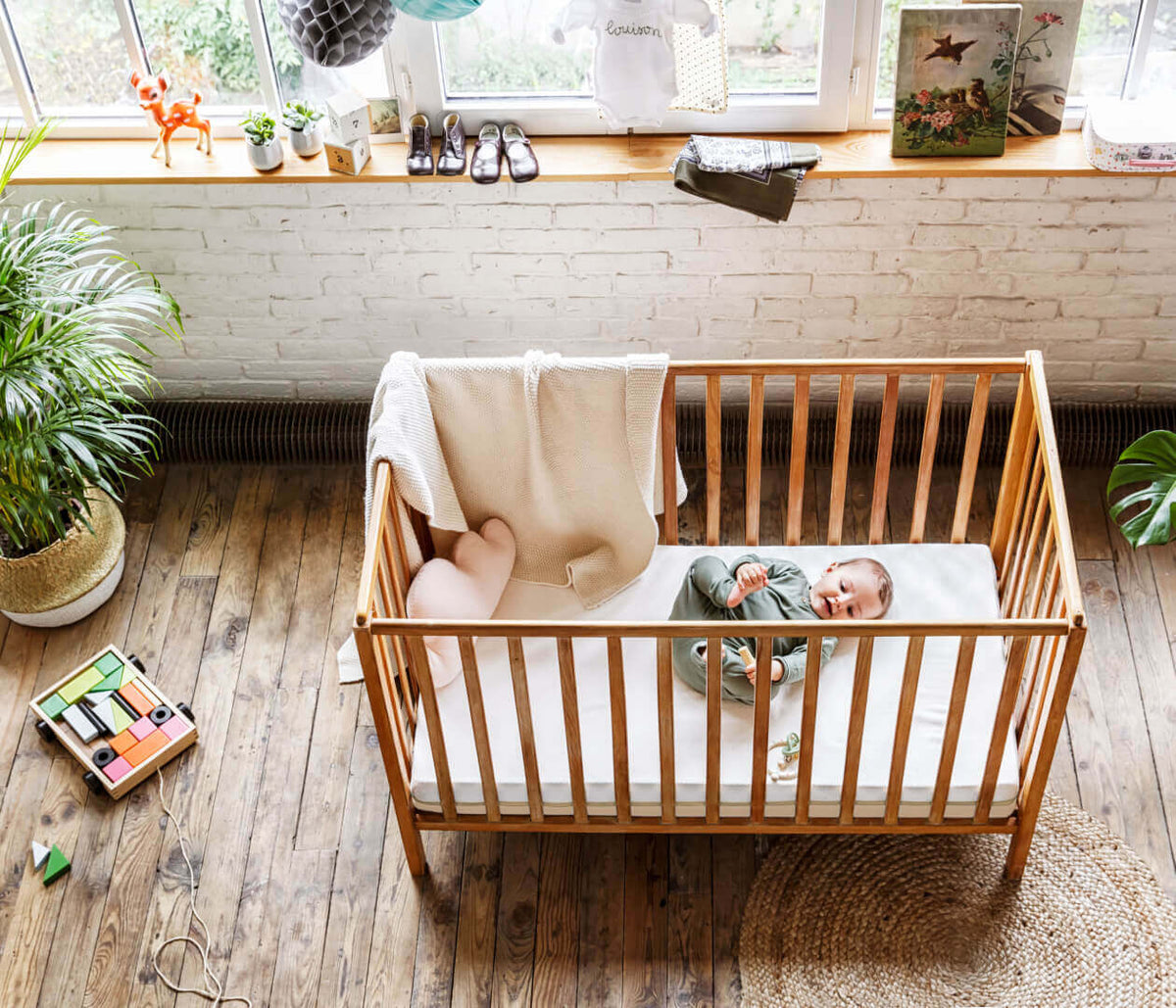
A healthy mattress, free of harmful substances
A baby breathes faster than an adult, and its airways are still developing: what it breathes while sleeping matters. Many baby mattresses are made of polyurethane foam, a petrochemical-based material that can emit volatile organic compounds (VOCs), which cause that “new” smell. Our mattress contains none of these. Its natural material is certified by three organizations:
- OEKO-TEX® Standard 100: Free of harmful substances.
- Eco-Institut: No emissions of VOCs or toxic substances.
- Eurolatex: a material processed in Europe and not blended with any synthetic material.
Baby Registry: Baby Bedding at the Top of the List
On a baby registry, the baby's sleeping set is at the top of the list: that's where your baby will spend most of their days. To make sure your list is complete, here's what to check before adding this sleeping set to your baby registry:
- List of sizes: 60x120 for standard beds, 70x140 for adjustable models, 80x160 for junior-sized beds.
- List of materials: organic cotton and Tencel® for the cover, free of synthetic foam and chemical treatments.
- List of certifications: OEKO-TEX® Standard 100, Eco-Institut, and Eurolatex.
- List of accessories: white or solid-colored sheet, waterproof and breathable mattress protector, sleeping bag suitable for the child's size.
A Checklist Before Buying a Baby Mattress
Keep this checklist handy when making your choice: a short list is better than a long list of criteria. Check off each item on the list for your child:
- First line of the list: the exact dimensions of the frame, with a tolerance of no more than two fingers.
- Second line of the list : un soutien suffisant, pour que le visage du nourrisson ne s'enfonce pas.
- Third item on the list: a removable, machine-washable cover.
- Last item on the list: certifications, which should be checked from the baby registry all the way through to the order.
Synthetic material, natural fibers, or pocketed springs: Which mattress is right for your child?
- Synthetic sleeping pad: lightweight and affordable, but it traps heat and can sag, especially in the center. Check its density: a low-density material quickly becomes too soft.
- Bedding made from natural fibers (coconut, wool): healthy and breathable, but coconut fiber is very stiff.
- A mattress with a pocket-spring core and a natural layer: stable support from the core, breathability, and natural elasticity. That’s why we chose this baby mattress.
Baby's Bedding: Breathable and Dry
Babies sweat a lot while they sleep, especially on their heads. Air circulates freely inside the mattress between the individual pockets, and the honeycomb structure of the natural layer wicks away moisture. The result: a sleeping surface that stays dry and cool, whether for nighttime or afternoon naps. This material is also naturally dust-mite-resistant and antibacterial, without any chemical treatments. If anyone in your family has a latex allergy, consult your pediatrician.
An organic mattress: a cover made of organic cotton
The cover is the only part that comes into contact with your baby, through their white or solid-colored sheet. Ours is made from a blend of organic cotton (61%) and Tencel® (39%)—a soft fiber derived from wood pulp—with a 100% cotton jersey lining. There’s no polyester or waterproof treatment on the cover—the mattress protector takes care of that, and it’s easy to change. Be sure to add a spare mattress protector to your baby registry—it’s a discreet must-have.
Standards and Certifications: What Should You Look for When Choosing Products for an Infant?
In Europe, mattresses designed for babies are subject to a specific safety standard, EN 16890, which regulates, among other things, firmness, dimensions, and the strength of the seams. When it comes to health, check the list of material certifications, then the checklist: OEKO-TEX® Standard 100 for the absence of harmful substances, and Eco-Institut for the absence of VOC emissions. Finally, be wary of low-density mattresses sold at very low prices: they sag quickly and do not maintain a stable, flat sleeping surface.
Sleeping surface: always flat, never sloped
The baby’s sleeping surface must remain flat. When lying on their back on a flat sleeping surface, the baby is in the recommended position: do not create an inclined surface under the sleeping area unless advised by a doctor. A flat, stable sleeping surface that fits the crib or bassinet exactly is the first safety rule. Before making a purchase, add the sleeping surface to your checklist.
Mattresses with removable covers, reversible mattresses, or adjustable mattresses: Which one should you choose?
A mattress with a removable cover is practically a must-have: on ours, the top part of the removable cover can be taken off and machine-washed. This removable cover is machine-washable at 30 °C, which makes it easy to care for the removable top section. “Winter side, summer side” reversible mattresses are mostly just a marketing gimmick for babies: the winter and summer sides offer no real benefit, since babies need, above all, the same stable and breathable sleeping surface in both winter and summer. As for the adjustable model, it’s mainly the frame that’s adjustable: choose the size that fits your baby’s current bedding—60x120, 70x140, or 80x160.
Bedtime, in winter and summer alike
For a good night’s sleep, keep the baby’s room between 18 and 20 °C, in both winter and summer. In winter, it’s the sleep sack that adapts to the season, not the mattress: a good sleeping surface stays the same all year round. Before each nap, make sure the sleeping surface is bare, and air out the room every day. Keep this checklist handy: even in winter, the bedtime routine stays simple for both babies and parents.
White bed, white crib, or wooden frame: the same rule applies
A white crib, a white co-sleeper, or a white bed frame: the color of the furniture doesn’t affect the mattress dimensions. Whether the crib is white or made of wood, measure the interior, then choose the model with the exact dimensions. A white fitted sheet, a white mattress protector, or a white sleep sack: white is a classic on the baby registry, but the most important thing is to choose linens made from natural materials that are easy to wash—for all babies.
Travel bed or folding mattress: Don't confuse the two
A travel mattress is a thin, lightweight, foldable mattress designed for occasional use: a weekend away, a vacation, or a night at Grandma and Grandpa’s. While convenient for travel, a foldable mattress is not a substitute for your everyday bedding. Before a trip, make sure your travel sleeping surface meets the same safety standards as at home: a flat, stable surface with the exact dimensions. On your packing list, also include a spare white fitted sheet and a mattress protector.
Our model is not a travel mattress: designed for babies’ everyday sleep, from birth to age 3, it comes rolled up in a box. For a trip, a travel mattress is still convenient; for every night, use the everyday model. When you return from your trip, your little one can go back to sleeping on their usual mattress, and the travel checklist can be put away with the packing list.
How long does a baby mattress last?
A baby mattress generally lasts until the child is about 3 years old. For a second child, add a new mattress to your baby registry, or at the very least, make sure it isn’t sagging or stained. Thanks to its natural material, which retains its shape and elasticity, and its pocketed spring core, our 13-cm-thick mattress maintains its support throughout this entire period.
And after 3 years?
When your child moves to a full-size bed, our children’s mattresses are here to take over, made with the same natural materials: the Essentiel children’s mattress, recommended for ages 3 and up, and the natural latex children’s mattress, available in 90x190 or 90x200. Keep these product numbers on your list—you’ll need them later.
Manufacturing and Delivery
Our baby mattress is made in Italy, near Milan, by a partner manufacturer founded in 1955 that specializes in natural latex, using raw materials from Sri Lanka, organic cotton from India, and Tencel® from Austria. It is delivered rolled up in a box, free of charge and by appointment. Add it to your baby registry, along with the list of accessories you’ll need.