

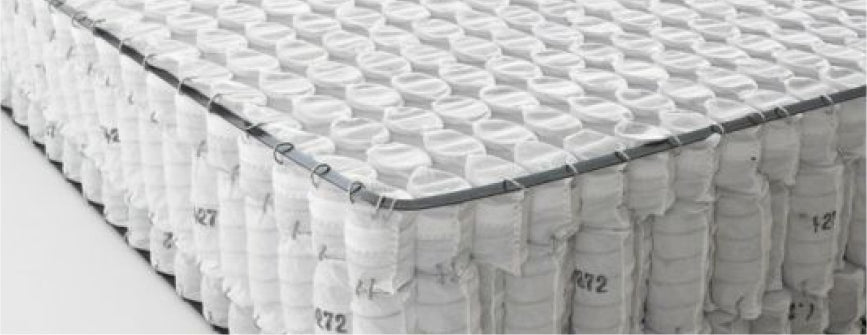
A box spring is an essential component for a good bedding setup and a good night’s sleep. According to experts, the box spring accounts for 30% of a bedding setup’s comfort, with the remaining 70% coming from the mattress.
Of all the different types of bed bases, the spring bed base is the oldest, even though it has evolved considerably to meet today’s demands. Gone are the days of springs that squeak with every movement, and gone too are the days of spring bed bases that literally collapse in the middle after just a few years of use.
We invite you to discover—or rediscover—the pros and cons of modern spring mattress bases, as we explore the various technologies that make it possible to offer high-quality products.
What is a box spring?
Unsurprisingly, the main feature of box springs is that they are made of metal springs. However, there are several technologies available, each with its own advantages and limitations that you should be aware of before choosing a specific model.
-
Biconical springs
Biconical springs, or independent springs, are spiral-shaped. Their profile resembles an hourglass, narrower in the center than at the ends. All the springs in the box spring are connected to one another by a steel wire, providing dynamic comfort that is firmer in the center of the box spring than at the edges.
It is often stated that bed bases with biconical springs allow heavier individuals to find a product suited to their body type, but it is important to note that this is true only if the bed base is paired with a high-quality spring mattress.
In any case, biconical springs are known for their low level of sleep independence, which means that when two people sleep together, one person’s movements are transmitted to the other, and vice versa. In fact, it’s not uncommon for couples to choose to combine two single spring mattresses to form a double bed, precisely to maintain an acceptable level of sleep independence.
-
The Pocket Spring Mattress Base
Pocket springs are considered to perform much better over the long term than other types of springs. This is because each spring is encased in a fabric pocket, just like in pocket-spring mattresses. Manufacturers most often use the term “fabric” to describe their products, but it’s important to know that these are actually synthetic foams—an important point to keep in mind if you want to avoid them to maintain a healthy and natural environment in the bedroom.
This technology provides numerous pressure points and areas of support for the body, resulting in much more ergonomic support that is distributed across multiple zones. In general, pocket-spring mattresses:
- help relax the muscles more effectively during the night;
- are more effective in terms of sleep independence, preventing the transfer of movement to the rest of the bedding.
The main drawback is that it is virtually essential to pair a pocket-spring box spring with a spring mattress to get the most out of it.
-
Continuous-wire springs
This type of box spring is very similar in design to the biconical spring box spring. The one major difference is that the springs and the metal links connecting them are made from a single long steel wire.
This design provides dynamic, multi-zone comfort, but its performance in terms of sleeping independence is debatable, especially when compared to slatted bed bases, which are far superior in this regard.
-
The Upholstered Spring Mattress Base
To conclude this overview of the various spring mattress base technologies, we think it’s worth noting that all these types of bases are available inan “upholstered base” version, in which the base frame is entirely covered with fabric. While the fabric enhances the bed’s aesthetic appeal, it can hinder the mattress’s ventilation and breathability, as air circulation is reduced by the fabric.
Which mattress should you choose with a pocket-spring or biconical-spring box spring?
This is where spring box springs of all types reveal their limitations and their main drawback. In fact, according to bedding experts, a spring box spring must be used with a spring mattress to form a spring bedding set.
In practice, this means you’ll have to replace your entire bedding set if you already have a mattress other than a spring mattress, which may raise budget concerns if that mattress is new, in good condition, and represented a significant investment.
Using a synthetic foam or natural latex mattress with a box spring is counterproductive in several ways. First, this combination—which is not recommended—prevents you from enjoying the optimal comfort and features of mattresses other than spring mattresses. In fact, these mattresses are designed primarily to be used with a slatted bed frame.
Furthermore, using a box spring with a latex or foam mattress can, over the long term, accelerate wear and tear and cause the mattress to age prematurely. This consideration should be weighed against the financial implications it entails, since it is clear that the money spent on a high-quality mattress should not be wasted due to an unsuitable bed frame.
People looking to purchase a box spring should therefore consider these factors and ensure they have a spring mattress as well—or even buy a spring mattress at the same time—which significantly increases the financial investment required to put together a cohesive bedding set.
Finally, it’s also essential to address the issue of back pain, which affects an increasing number of people and plays a role in their choice of bedding. People suffering from this condition need firm support to get a pain-free night’s sleep. However, the support provided by innerspring mattresses is far from universally praised, as they are often considered too soft or too pliant. Slatted bed frames, on the other hand, provide better results for relieving back problems.
We recommend these other pages:
- Classic Beds: What Factors Should You Consider to Make the Right Choice?
- The Benefits of a Storage Bed or a Bed with Drawers
- The Pros and Cons of Electric Beds
- The round bed: an original and stylish choice
-
How to Choose the Right Bunk Beds?
- How to Choose a Canopy Bed?
- Why choose a convertible bed?
- The Benefits of a Fold-Down Bed