

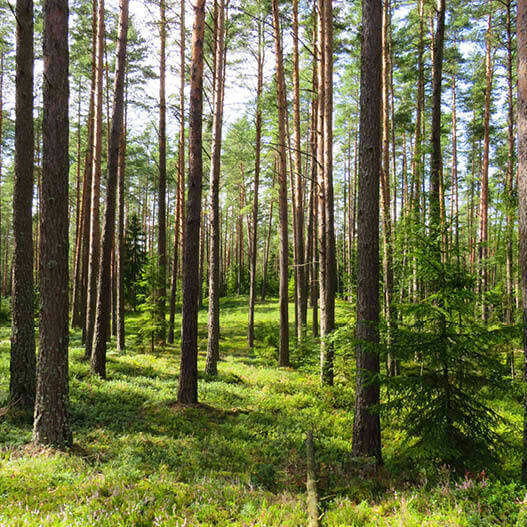
The trees scatter the gold of their leaves through the windows of autumn. — Sylvain Tesson, *In the Forests of Siberia*, 2011. For the hiker, forests are a seasonal wonder. Do they allow you, too, to recharge your batteries, just like this author who spent six months on the shores of Lake Baikal? Their positive impacts on humans are well established, and their benefits extend far beyond that. Once covered 50% by forests, the Earth’s landmass—which is now about 30% forested—sees its carbon footprint reduced by a third thanks to these carbon sinks. These 4 billion hectares of habitats for biodiversity—more than half of which are located in Russia, Brazil, Canada, the United States, China, and the Democratic Republic of the Congo—are now partially threatened by massive deforestation. France, ranked fourth in Europe behind Finland, Sweden, and Spain with its 18 million hectares, has recognized the importance of this issue. The National Forestry Office aims for sustainable forest management through “a fair balance between timber production and ecosystem conservation.” According to this organization, the volume of French forests has doubled over the past 150 years.
At Kipli, the wood used in our eco-friendly furniture is sustainably sourced and processed in Normandy, in accordance with sustainable forest management practices. The same applies to the sap from Asian rubber trees used in our natural latex mattresses, which carry the Eurolatex label—100% natural latex. We’re committed to protecting our Earth’s “green lungs,” so we’re thrilled to see virtuous initiatives flourishing all around the globe. Here are our 8 favorites. At the end of the article, you’ll also find our favorite fun facts about forests!
Nantes, Lyon, Paris: Highly Resilient Primary Microforests
Planting a small forest 30 times denser than a traditional forest, 10 times faster, to support 100 times more biodiversity…That was the dream of Japanese botanist Akira Miyawaki. A dream come true, which two residents of Nantes—Stéphanie and Jim—have taken up. The founders of the MiniBigForest nonprofit are planting trees by the hundreds, which quickly sprout from beneath the mulch (dead leaves, wood chips, etc., which prevent water from evaporating too quickly).
Baby elms, ash trees, and oaks—what’s the point? In two years, they reach 2 meters; three years later, they form a wild, tangled mass that’s far more resilient than a neatly ordered forest. And above all, they are home to a hundred times more small creatures… How do you go about creating this kind of microforest? You identify the tree species around the area where you want to plant and choose these native trees. You plant them at a rate of three to five per square meter, under a thick layer of mulch, just like in primary forests. Then, you let nature take its course. The people of Nantes hope their initiative will inspire others to follow suit, since each planted area acts as a barrier against noise and pollution, captures carbon, and supports biodiversity. Grab your seeds and shovels!
In the same vein, a 100% green initiative has been launched in Lyon using this Japanese method. This fall, residents of the Duchère neighborhood will plant between 4,500 and 6,000 trees across 1,000 m² at the foot of the Résidence du Plateau Sud. So, would you like to go plant your own? And Paris isn’t far behind! Boomforest uses the Miyawaki method to plant trees in spaces provided by local governments in the Île-de-France region, much to the delight of local residents. Montreuil, Porte des Lilas, Malesherbes… With their mini-forests, they help reduce pollution and give Parisians a breath of fresh air. Kipli is a partner of Boomforest, having funded their efforts in 2019 and 2020 through the organization 1% FOR THE PLANET. Keep an eye out for the next project—you can join in!
One Million Trees in Val-d’Oise
This is the largest reforestation project in 400 years: one million trees are being planted across 1,350 hectares. Former vegetable-farming lands, whose soil had been severely degraded, were acquired to plant elms, oaks, maples, ash trees, and linden trees… In total, about 30 tree species resistant to soil pollution have been selected. In ten years, the trees will be well established, and in 50 years, this area should look like a real forest. 85 million euros have been spent to benefit biodiversity and local residents. Hooray!
India: A Devastated Forest Replanted by a Community of Volunteers
At Sadhana Forest, nearly 1,000 volunteers from all over the world come together year-round. Their goal: to replant the trees that have been lost to deforestation and intensive agriculture, as well as to revitalize the soil and replenish the water tables.In this lush green setting near Pondicherry and Oroville, extensive forest and water conservation efforts have been underway for the past 15 years. For Aviram Rozin and his wife Yorit, the founders of this project,“green gold and blue gold are the two main resources of the 21st century.” They are determined to protect them on their own scale. Their project has inspired similar initiatives in Haiti and Kenya. Learn more about this initiative on the Sadhana Forest website and inthe article by Mr. Mondialisation.
Egypt: Wastewater Turns a Desert Into a Forest
Egyptian researchers have succeeded in establishing the “Serapium Forest” in the middle of the desert, two hours from Cairo. This project was carried out as part of a plan to reforest 36 desertified areas across the country, launched in the 1990s. The project involves planting dozens of tree species, some of which were imported, such as eucalyptus and mahogany. In total, 200 hectares of trees now thrive in an ideal climate for growth. The researchers found that the trees were growing four times faster than they would in a temperate climate like that of mainland France.
How did the Egyptians pull off this feat? By applying the ideal growing method: sunlight + water + nutrients. Right in the middle of the desert, the ingenious project leaders built a wastewater treatment pond to provide a plentiful supply of “blue gold” to water the forest. A stroke of genius, because thanks to the nitrogen and phosphate contained in the filtered water—which is still unfit for consumption—there’s no need for chemical fertilizers. The trees love it, and it shows. The cycle is complete—mission accomplished! To learn more, checkout Mr. Mondialisation’s article.
A Giant Edible Permaculture Forest in Seattle
It’s a bit of a crazy place… The Bacon Food Forest is one of the largest edible forests in the world. It’s located right in Seattle, and the project brings together 100 volunteers across several areas. There’s a huge orchard, a vegetable garden, a community garden…But there are also communal spaces: the “Gathering Plaza” is a place for people to come together, and the kids’ corner is a spot where children can play and learn the basics of permaculture and community living. How does the forest work? Almost all the trees bear fruit or nuts and provide shade for the berries, vegetables, and flowers growing beneath them. By combining this method with the principles of permaculture—which aims to revitalize the soil for greater plant productivity—extraordinary yields are achieved . It’s a model for a food forest that’s gaining more and more followers around the world.
Costa Rica: A Forest Grows in an Arid Region on Orange Peels
In the 1990s, Daniel Janzen and Winnie Hallwachs, two researchers from the University of Pennsylvania, partnered with Del Oro, a Costa Rican orange juice producer. They proposed an eco-friendly solution for the company’s green waste: dumping orange peels and pulp into nearby, nearly desert-like fields. The goal of the experiment was to test the hypothesis that the nutrients in orange peels could restore soil health. Accused by a competing company of contaminating the soil, the researchers abandoned the approximately 12,000 metric tons of orange peels delivered by 1,000 trucks. End of the story? Not quite, because in 2013, a team from Princeton University returned to the siteand found that biomass had increased by 176% in these fields…transforming the area into a jungle. Their soil analyses revealed a high concentration of nutrients beneficial to plants. In light of this success, researchers at Princeton University are proposingto use food scraps to create tropical forests. To learn more, check outthe article in The Epoch Times.
China's First Forest City
Stefano Boeri, the architect behind Milan’s “forest buildings,” has a new, massive project. This time, he’s heading to Guangxi Province in southern China to create the world’s first “forest city.” Spanning 175 hectares, the visionary architect plans to build a city for 300,000 residents designed to blend seamlessly with nature. Plans for Liuzhou call for 40,000 trees and one million plants, which are expected to absorb 10,000 metric tons of CO2 and 57 metric tons of pollutants per year, while producing some 900 metric tons of oxygen. This city is expected to be 100% self-sufficient in renewable energy from solar and geothermal sources. The plants will help lower the site’s temperature, promote biodiversity, and provide sound insulation. The city will be equipped with electric rails for… cars! Can you beat that?
Bonus: Did you know?
- Forests currently cover 31% of our planet's land area.
- 1.6 billion people depend directly on forests for their livelihoods.
- A tree can absorb up to 150 kilograms of carbon dioxide per year. The 400 billion trees in Europe absorb 9% of the continent’s carbon emissions.
- 35% of forest biodiversity is found in dead trees.
- More than 15% of our medicines come from plants found in tropical forests. However, we have studied only 1% of the plants found there.
- In Switzerland, 2,000 volunteers come together every summer to plant trees.
- France's forestry sector generates 60 billion euros in revenue annually, accounting for 3% of GDP.
- Primary forests cover 6% of the planet. They receive between 250 and 450 centimeters of water per year. They can even cause rain to fall!
- Some Tasmanian pines can live for 2,000 years.
- The world’s oldest living organism is a Posidonia seagrass meadow that is currently between 80,000 and 200,000 years old. Portuguese researchers have studied these Posidonia seagrass beds off the coast of Formentera in the Balearic Islands. This seagrass bed is under threat: it is shrinking by 5% per year due to pollution in the Mediterranean. Scientists are working hard to protect it.
We hope you enjoyed this article.
Of course,
Nora Leon for the Kipli team¹ According to the Food and Agriculture Organization of the United Nations (Source)² 2018 Report from the ONS (National Forestry Office) (Source)³ French Forests: Key Figures (Source).⁴ 12,000 metric tons of orange peels created a lush forest in Costa Rica, The Epoch Times. (Source)⁵ UNECE (Source).⁶ UNECE (Source).⁷ UNECE (Source).⁸ The ONF in Figures (Source)⁹ UNECE (Source).¹⁰ French Forests: Key Figures (Source).¹¹ National Geographic for Kids (Source).¹² National Geographic for Kids (Source).