

Today, more than 90% of mattresses sold are made from synthetic materials. These include: polyurethane foam mattresses (the most affordable), memory foam mattresses (made from heat-sensitive polyurethane), pocket-coil mattresses (combined with various types of synthetic foams), and synthetic latex mattresses. Less than 10% of mattresses are therefore natural mattresses, made either from natural latex or wool.
That’s a lot (A LOT) of synthetic mattresses. And a lot (A LOT) of petroleum-based raw materials—from the most polluting industry in the world... In fact, these mattresses sell very well because they’re generally cheaper and well-marketed: the sales pitches are persuasive, the headlines are catchy, and there are promotions everywhere.
But these products often come with several problems:
- There is a great deal of uncertainty regarding their composition, which is often 100% synthetic.
- They lose their shape fairly quickly, after just a few years.
- Chemical treatments ( fire-retardant, anti-mite, etc.) help offset the problems associated with synthetic materials.
- Excessive night sweats occur because the foam has poor breathability.
- Prices that are constantly fluctuating and being slashed, with price differences ranging from 1 to 10 for products that are virtually identical.
- The end of a mattress's life... which very often ends up buried underground.
So, can we really talk about good value for money? What if we focused instead on the sustainability-to-price ratio? When we look at the price on the label, we tend to forget how it might reflect a brand’s commitments—or, conversely, the lack thereof. That’s because a product’s cost is made up of many factors, such as the price of raw materials, manufacturing locations, labor costs, and overhead expenses…And behind each of these factors lies a decision to be made. Every decision is a commitment. Read this article to learn more about our beliefs and our approach—which is to create the conditions for a more sustainable world 🌿!
Choosing Natural Over the Ubiquity of Synthetics
Less than 10% of mattresses are natural—that’s not very many. Nevertheless, we chose to be part of that group for obvious environmental reasons. So, natural is the way to go, but there were several options to consider. Find out what we chose and why.
Kipli Mattresses: Explore the depths of its soul!
100% Natural Latex: Why Choose It?
To design an eco-friendly mattress, two main raw materials are used: wool and 100% natural latex. So-called eco-friendly foams made from soy are starting to appear on the market, but they are composed of 80% synthetic and 20% natural materials. Well...
Let’s set the scene a bit.As you may already know, Kipli is, above all, a family story. It’s a beautiful story about passing on values, a precious legacy, and a torch to be carried forward. Let us tell you all about it—make yourself comfortable…
It all started with Mario, Davide’s uncle (the co-founder of Kipli). It was the late 1980s. At the time, Mario was working at Pirelli, in one of their factories that manufactured synthetic latex mattresses. In 1998, driven by his environmental convictions and recognizing the ecological impact of synthetic latex production, Mario decided to leave his company to start his own mattress factory—this time using natural latex —in the Milan area (one of only three such factories in Europe).
For him, natural latex was already the material of the future—one that could replace petroleum-based products and make them not only more sustainable but also healthier for people and the environment. And for good reason— 100% natural latex is a workhorse! It allows a mattress to last 12 to 15 years, unlike synthetic materials , which have an average lifespan of 7 years. Latex is also the most breathable material, offering a perfectly balanced combination of comfort and support. It’s biodegradable and requires no chemical treatment, as it’s naturally dust-mite-resistant and antibacterial. To top it all off, latex is a raw material with the most positive CO2 footprint for the environment.
Davide, Mario’s nephew, then took up the torch. He was both convinced that alternatives to mattresses filled with harmful materials needed to be found and highly motivated by the idea of writing a second chapter in his family’s saga. Davide therefore teamed up with Antoine to create the Kipli brand. Together, they set a goal: to develop natural latex mattresses in Europe—a healthy and sustainable product. This was something Mario hadn’t managed to do, as he sold primarily in South Korea and Japan. With the Kipli mattress, Antoine and Davide were also determined to make a product more widely accessible—one that had previously been sold only in specialty stores at very high prices.
When it comes to the ecological transition, we are among those who believe there is no time to waste. According to the Intergovernmental Panel on Climate Change (IPCC), we have 20 years to act.
Designed for comfort, made in Italy. Before launching the Kipli mattress as envisioned by Mario, we spent time designing a model that could adapt to everyone’s needs. We wanted the Kipli mattress to be reversible so it could suit all tastes. And it comes in two firmness levels: soft and firm.
Many brands limit the thickness of natural latex in their mattresses to cut costs. We didn’t compromise: we chose a thickness of 20 cm because, in terms of comfort and durability, it’s truly the best. During our testing phase, we compared many different cores—including those from our current partner (which largely took over Mario’s operations in 2017) as well as cores manufactured directly in Sri Lanka, where most of the natural latex comes from. That’s right— a large portion of the mattresses sold in France have cores (foam) processed directly in Southeast Asia, where rubber tree plantations are located. It’s important to know that natural latex, collected in liquid form, must undergo a vulcanization process to become solid. The latex is then “dried” and thus becomes the “core” of the mattress ;-). In Asia, the factories are fairly outdated. However, to ensure the highest quality, manufacturing processes must be rigorous, and the latex drying phase is crucial—if it isn’t done properly, there’s a risk of serious issues with odor and durability. And it’s also quite difficult to verify compliance with social standards in those countries...
In Europe, there are only three natural latex factories—in Italy, Belgium, and Bulgaria. Bulgaria wasn’t an option for us. To source production as locally as possible, our choice could not be limited solely to Italy or Belgium. Of course, our first thought was to turn to the new factory in Italy—the one that had taken over Mario’s business (who had sold his factory in 2017). But we were determined to explore all options. The factory in Belgium specializes primarily in 85% natural latex. For reference, the European standard sets the minimum natural latex content at 85% to qualify forthe “100% natural latex”designation. However, it is possible to have up to 97% natural latex in a mattress core (the remaining 3% consists of vulcanizing agents used to transform liquid latex into foam—primarily potassium and zinc oxide). And that was the specialty of the Italian factory.
So we decided to turn to the Italian factory. This factory, in addition to having a special relationship with us, offered the product that best met our expectations and, in our view, was of the highest quality.Special heating, infrared rays to dry the deepest parts of the core (yes, we know it sounds weird to say that), drying on both sides (the mattress is actually flipped over): ultimately, the product wasof higher quality and the quality control was well managed. Manufacturing in Italy was therefore the best choice.
Why this mattress cover and not another one?
Nearly 80% of the mattress covers on the market are made of polyester. Affordable and machine-washable, they seem like a great choice at first glance. But there are plenty of alternatives. Covers can also be made from cotton, linen, lyocell, viscose, and other materials. A traditional cover consists of two parts: the outer fabric—the part you see on the outside of the cover—and the filling inside the cover, which gives it its quilted texture.
The fabric of the cover, the ticking
Initially, our canvas was made from traditional cotton. At the start of the Kipli adventure, we had a hard time sourcing high-quality organic cotton fabric. But switching to a more eco-friendly fiber was a top priority for us. We finally found the fabric we wanted over a year ago in Belgium, at a Belgian weaver’s. To take our commitment all the way, we chose unbleached organic cotton.Yes, it’s a little-known fact, but natural cotton isn’t white. Its natural color is slightly off-white once it’s spun and woven. Virtually all cotton is bleached with fairly harsh chemicals. The choice was an easy one.
The filling of the cover
Another important factor in the design of the Kipli mattress was the filling of the cover.Before discussing the material used, it’s important to talk about the different types of covers, since some don’t have any filling. There are two types of covers:
You have the “sandwich” covers. These covers are mainly used in low-cost mattresses, which make up the majority of the market. They’re quite fragile and offer no additional comfort. These covers are made of fabric (ticking) that is pulled tight and sewn in the middle around a zipper. There is no filling in this type of cover. The advantage of this cover is, of course, its cost, which is kept as low as possible. However, the comfort and durability of such a cover are very limited.
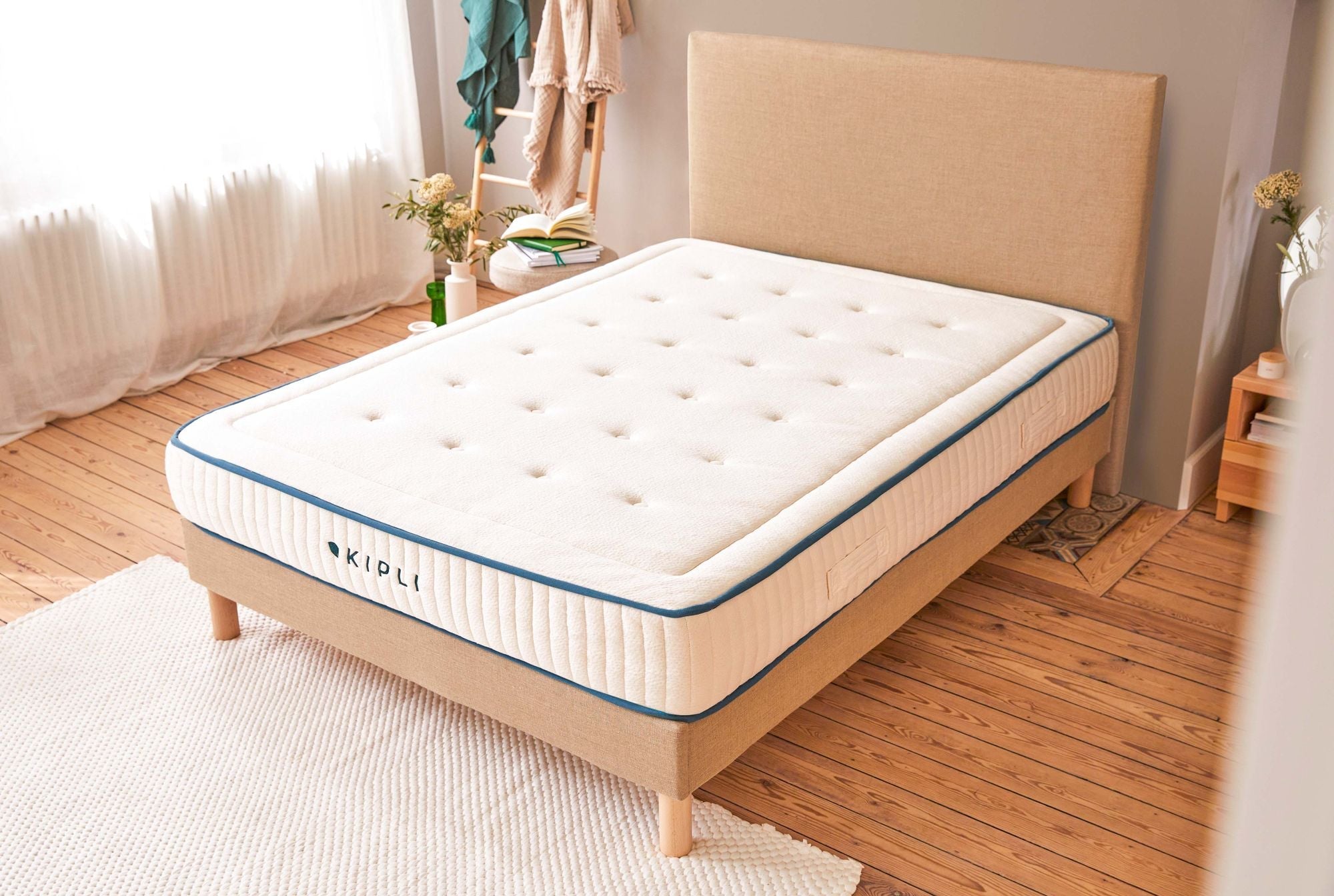
You can enhance this type of cover by adding padding, which increases its comfort and coziness. The other option is the traditional cover. These covers are sturdy, durable, and comfortable thanks to their padding. Made with superior quality, they are often hand-sewn . They are most easily recognized by the presence of a border like the one shown here.
Although it takes longer to produce, this cover is often a mark of the mattress’s quality. Found primarily on high-end mattresses, it costs 2 to 4 times more than “sandwich” covers. This cover provides strength, comfort, and durability to the mattress. For us, there was no question of offering a low-quality cover that wouldn’t last as long as our mattress! Yes, we tend to value harmony and consistency here at Kipli. So we chose a traditional cover with strategically placed quilting over the filling—the ultimate touch that adds a unique flair (the fact that the quilting is placed on the mattress and is independent of one another).Our cover is made of organic cotton and Tencel for the outer fabric and will be filled with Patagonian wool. This ensures a cover free of synthetic fibers— one that’s durable, cozy, and naturally fire-resistant thanks to the wool.
To keep it 100% natural, we had to compromise on machine washability. Especially since it’s difficult to wash our mattress cover—which is quite bulky—in a home washing machine.
The cover on our natural latex mattress is dry-clean only.
Services and Warranties
No compromises: we wanted the very best for our services and guarantees. So we really thought through the entire experience from start to finish to avoid falling into the classic—and all too frustrating—pattern: paying for a high-quality product only to have it delivered in a… very sloppy manner. Packages tossed over the fence, left on the doormat, delivered late… We’ve heard it all before.
The premium delivery service was the best choice: delivery is completely free, and the mattress is delivered by two delivery people ( which is a good thing, given how heavy the latex is), right to your home in the room of your choice, on the date you choose, and within a 2-hour time slot. As for the warranties, we—who love to joke around with our coworkers—weren’t kidding: the mattress comes with a 10-year warranty, and you get 100 nights to try it out and get used to it. Not to mention that all returns are free!
So, how much does it cost?
We realized several things before launching the product, including that: - distribution costs are particularly high in the furniture and bedding industry. In other words, relying on specialty stores or large furniture retailers to sell the products drives up the retail price. - Brands’ operating margins—that is, the portion of profits that bedding brands keep to cover their own costs—are often substantial. This is why they’re often able to offer sales and promotions of all kinds. Based on these observations, co-founders Antoine and Davide decided to go against conventional practices: the Kipli mattress will be sold by Kipli itself at low margins—or not at all. We’ll let you figure out the rest...
“A fair price is, above all, fair profit margins”
"Antoine keeps telling us this to instill the company culture in everyone," he says. It works! We know the phrase by heart now.“The net margin on a mattress is 7%.”
That is how we have been able to offer a 100% natural latex mattress at prices half as much as those of mattresses of the same quality and with similar features sold in large retail stores.

This is not a feat; it’s a choice.
In conclusion...
Because sleep should be the most natural thing in the world, our entire team has been working tirelessly every day for the past three years to make your bedrooms healthier by offering a healthy, durable mattress at a fair price. Through transparent communication about materials and pricing, we want to empower you to buy your mattress with all the necessary information at your fingertips —to shop mindfully, just as you would meditate.