

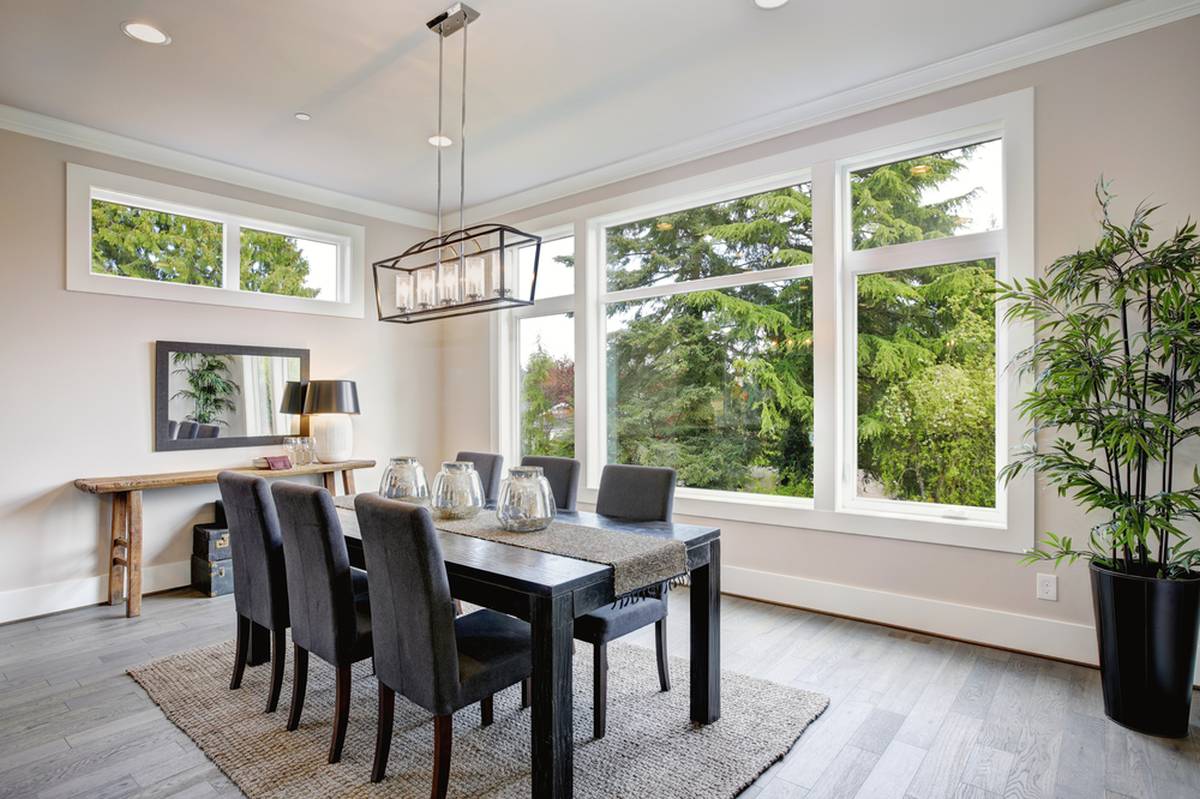
Tips for Designing a Complete Dining Room
Designing a complete dining room involves more than just choosing a dining table. There are many other factors to consider when planning this space dedicated to meals. Let’s first take a look at what makes up a complete dining room and what can be added or removed.
Next, we’ll look at how the different areas of this room can be arranged within a home to optimize the dining room’s function. There are ideas and tips that allow for an efficient layout while enhancing the room’s atmosphere.
Finally, we’ll discuss the design and decor aspects of a dining room. The furniture and decorative elements can be better coordinated to enhance the style of this central room.
The Layout of a Dining Room
The dining room is a central room in a home. It is where the family gathers for meals, as well as where guests and visitors are welcomed. By extension, a dining room can be called a “living room” if the residents spend most of their time there. It’s a living space designed for socializing and sharing. Of course, a traditional dining room consists of furniture that’s almost always found there:
- a dining table (sometimes also called a living room table);
- matching chairs;
- a china cabinet or a sideboard (sometimes placed in the kitchen if the dining room is too small).
Aside from decorative items, there isn’t a great deal of furniture in this space, which is often the largest room in the house. But in addition to the pieces mentioned above, there are other types of furniture that can be included in a dining room, as well as stylistic elements (decor and design). This is the case, for example, with:
- a backsplash cabinet;
- a side table;
- a sideboard;
- artwork, photographs, and paintings;
- a chimney or a fireplace;
- etc.
It is, therefore, all of these elements that must come together harmoniously to create the dining room’s atmosphere and ensure a welcoming space centered around the dining table.

The Dining Room Layout
As we have seen, a dining room is a space furnished with furniture and decorative elements, designed to accommodate people—whether for a meal or not. To this end, the furniture should be arranged tastefully, keeping in mind certain rules that make the layout easier.
- You should always try to place the dining table in the center of the room, or at the very least, avoid placing it against a wall—even if it’s only along one side. This would immediately detract from the room’s aesthetics, even if there are still enough seats available.
- Chairs must be able to be moved back to allow people to sit down (they must be at least one meteraway from the wall, or even 1.25 meters if there is a pathway behind the chair).
- Walkways (such as from the kitchen to the living room) must not be blocked when people are seated at the table. A minimum of 90 cm of clearance is required.
- If the sideboard or china cabinet is tall, it shouldn’t be the only item taking up space along the upper part of the wall. A painting or other decorative element should balance the wall in front of it (or on either side of it, in the case of a long wall), so that it doesn’t appear massive and imposing. This way, the upper sections will be “dressed” symmetrically, and a sense of balance will be achieved.
- Furniture such as sofas or armchairs should be avoided in the dining room. This creates a mix of styles, and it is better to place them in a living room, even if the living room is adjacent to or open to the dining room.
- The lighting must be sufficient for everyone to see clearly, such as a warm white light (between 2,200 and 3,000 kelvins) in adequate quantity. The dining room is not a living room; it is a place for serving meals, eating, and engaging in conversation. If manual activities occasionally take place there (sewing, arts and crafts, etc.), temporary spot lighting (halogen, portable lamp) may be set up on a temporary basis.
- Decor and style are a matter of personal preference, and for that reason, the homeowners’ tastes will be the sole determining factor in how the space is arranged (with or without the help of an interior designer).
The list of tips and rules above is neither exhaustive nor set in stone. It all depends on the individual and the specific layout. However, dimensions are important—for example, having a large dining table in a small dining room would be impractical and unattractive. It’s important to maintain the right proportions.
The decor and atmosphere of a dining room
The dining room is often the room that gives a glimpse into the rest of the house—areas that are usually hidden from passing visitors (the sleeping area, the master suite). You can often get a sense of the home’s overall decor just by exploring the dining room.
It is therefore important to know how to give it an original and attractive look, while following a few simple guidelines to enhance the overall impression created by a dining room. Here’s how:
- The furniture (dining table, china cabinet, chairs) should match and complement each other;
- the decorative elements will not clash with one another, even if, taken individually, they do not perfectly match the style of the furniture;
- The colors and materials (not counting the white of the walls) will be limited to two. Small accents of a third color may be used sporadically and consistently while remaining subtle;
- The combination of cool colors (blue, black, white) and warm colors (orange, magenta, yellow) will not be used in the same room. Even though the dining room has no door and is an open space, the color scheme will be designed to avoid spilling over—even partially—into the other rooms, so as not to create asymmetry.
These rules aren't set in stone, either. You have to know how to balance them with your own tastes and preferences. Designing a dining room is also about successfully adding a personal touch—a signature style. For example, if the homeowner paints beautiful pictures, it’s perfectly acceptable to hang them there for visitors to enjoy. But the set of rules mentioned above simply helps, at times, to avoid lapses in taste that could ruin the overall look.
In conclusion, designing a dining room effectively means striking the right balance between your desires (which can sometimes be limitless), the room’s size, and the home’s overall atmosphere. Furthermore, whether the dining room is for a couple living alone or a large family makes a big difference. And it matters even more depending on the layout of the space (whether the dining room is open to the living room and kitchen or separated by a wall, located in a sunroom, or integrated into the kitchen, etc.).
So, first you need to analyze the current situation in order to successfully plan for the future. There are many software programs that let you redesign a living space while incorporating decorative elements, giving you an idea of what the final result will look like. So don’t hesitate to use them.
We recommend these other pages:
- How do you determine the right size for your dining table?
- What shape should you choose for your dining table?
- What material should you choose for your dining table?
- What are the benefits of choosing a solid wood dining table?
- What does PEFC certification mean for a wooden dining table?
- What color should you choose for your dining table?
- How Do You Choose the Right Style for Your Dining Table?
- Extendable Dining Table: Why and How to Choose the Right One?
- How to Choose an Extendable Rectangular Table?