

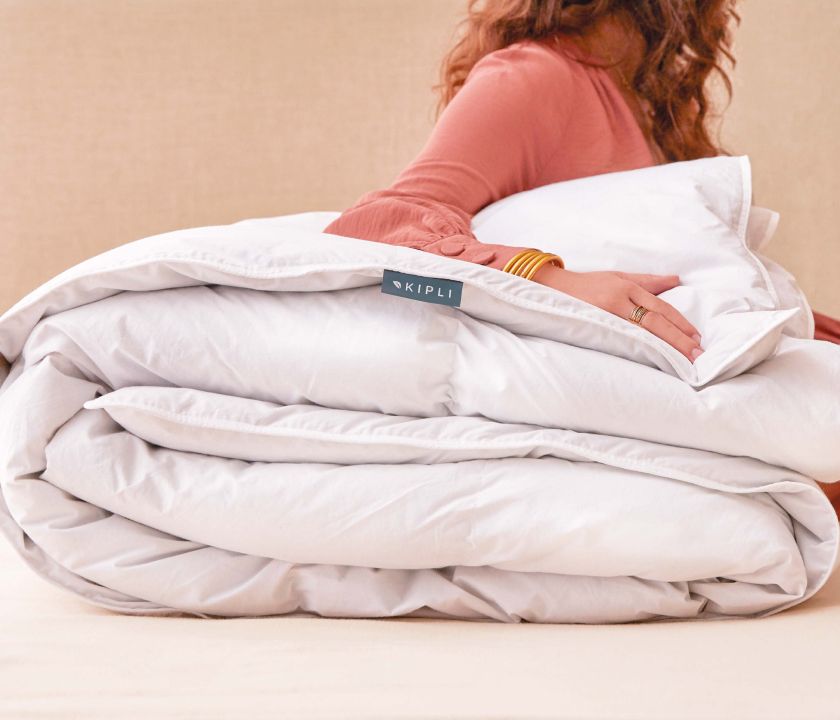
Choosing the right comforter is essential for a good night’s sleep, and adapting it to the seasons is just as important. Too hot, too cold—it can sometimes be difficult to find the right balance. As winter approaches, it may be a good idea to invest in a comforter better suited to falling temperatures, one that will keep you warm and ensure a better night’s sleep.
But how do you choose? Warmth, thread count, filling, price. Today, there’s a huge variety of models on the market, designed to meet every need. However, it can quickly become difficult to navigate all these options and technical terms. Yet there are solutions to suit everyone: check out our guide to choosing the perfect comforter and enjoy a good night’s sleep.
Many factors to consider
Once you've determined the right size comforter to buy based on your bed, there are several factors to consider to make the right choice. These characteristics are particularly important when choosing a winter comforter, but they're also important when choosing a summer comforter or an all-season comforter.

The Importance of the Filling: Natural or Synthetic?
When it comes to comforters, there are two main categories: natural comforters and synthetic comforters.
When it comes to synthetic comforters, most are made of polyester fiber (sometimes recycled): these comforters are often less expensive, but also of lower quality. Within this category, there are several types of fibers:
- solid fibers;
- hollow fibers;
- silicon-coated hollow fibers;
- microfibers.
Some will be more comfortable than others, but overall they will be less effective and less durable than natural comforters. However, in addition to their more attractive price, they have the advantage of being a sure bet for people with allergies.
When it comes to natural comforters, there are several types of fillings available. These include:
This last option is undoubtedly one of the best choices, since, in addition to being a natural and sustainable solution, lyocell (or Tencel) is environmentally friendly and does not harm animal species. Furthermore, it is antibacterial, making it ideal for sensitive skin.
Kipli has therefore chosen to offer comforters filled exclusively with lyocell: in addition to all its other benefits, its thermoregulatory properties make it the perfect choice for a good night’s sleep.
The duvet cover
Since it comes into direct contact with your body—just like your bedding—the duvet cover can have a significant impact on how the duvet itself feels against your skin. The material chosen for the cover can also affect heat retention or loss. Generally speaking, cotton covers are the most common. However, there are many alternatives, such as silk or bamboo, each with its own advantages.
Cotton is still the clear winner in this regard, both in terms of temperature regulation and comfort. It is widely used for duvet covers, but it’s important to note that not all cotton is created equal: it’s best to choose 100% organic cotton that has not undergone any chemical treatment. This is the material specifically chosen for the Kipli natural duvet.
Finally, the stitching—which refers to the seams on the duvet cover—is also important. Its primary function is to keep the filling in place, and it affects not only the duvet’s ability to retain heat but also its loft.
The warmth rating and weight of the comforter
This is surely one of the most important factors to consider when looking for a comforter to keep you nice and warm while you sleep:the comforter'swarmth rating. It is generally measured on a four-level scale:
- a lightweight comforter, which is generally not suitable for winter unless you are very sensitive to heat and/or your bedroom is heated;
- a medium-weight comforter, for people who aren't easily cold and/or for rooms with moderate temperatures;
- a warm comforter, for those who like to sleep nice and warm and/or for rooms that aren't very warm;
- The extra-warm comforter, designed for those who feel the cold easily or for use in unheated rooms.
The weight of the comforter, meanwhile, is closely linked to the warmth rating: it corresponds to the density of the comforter’s filling and thus determines its ability to retain heat. Weights generally range from 125 g/m² (for the lightest comforters) to 500 g/m² (for the warmest comforters). Thus, the higher the weight, the warmer the comforter will be. Note, however, that the weights differ between natural and synthetic comforters.
In fact, this weight depends largely on the composition of the filling: for the same level of warmth, a synthetic comforter will inevitably be heavier than a natural comforter (in the case of a natural comforter, the proportion of down can also affect the comforter’s weight and its weight per square meter).
Here are some factors to consider when making your purchase: First, keep in mind that to achieve the same level of warmth, a synthetic comforter will require a higher fill weight. On the other hand, the total weight of the comforter is a factor that should not be overlooked: some people cannot stand feeling the weight of a comforter on them while they sleep, while others feel more comfortable with a heavier one.
Choosing the Right Duvet: A Matter of Taste
Ultimately, there is no one-size-fits-all solution: your choice will depend mainly on your needs and preferences. The size of your bed and mattress, the temperature of your bedroom, and your sleep habits are all factors that should guide your choice, as are your personal preferences, whether the bedding is machine-washable, and any allergies you may have to certain materials or dust mites.
Your budget can also be a deciding factor, since there is now a very wide range of prices, as well as a wide variety of duvet qualities. There's something for everyone, at every price point!
We recommend these other pages:
- How to Wash a Duvet
- What size comforter should I choose?
- What size duvet should I choose for a single person?
- What size duvet should you choose for two people?
- How do you choose a comforter for a child?
- How do you choose a comforter for a baby?
- What kind of comforter should you choose for the summer?
- Should you choose a 4-season comforter?