

In this article, learn the key facts about comparing foam, latex, and spring mattresses.
We spend about 30% of our lives sleeping. The quality of our sleep directly determines our ability to recover and how well we’ll function during the day. This quality depends largely on the type of mattress we use. Are you thinking about getting a new mattress and wondering whether to choose a foam, latex, or spring mattress? Here are our tips.
A COMPARISON OF FOAM, LATEX, AND SPRING MATTRESSES IN A FEW POINTS
Three different technologies are vying for your attention. It may come down to budget, but it’s also a matter of personal preference. We’re all different, and what matters is that the mattress meets our expectations and our idea of comfort. Foam mattresses have a reputation for being entry-level models. That’s true, but it’s no longer automatically the case, as there are now more expensive models available—such as memory foam mattresses. In any case , foam mattresses offer the widest range of prices. These are petroleum-based foams, which generally have relatively low quality and durability (about 7 years).In-spring mattresses are all the more comfortable when they have a high number of springs and when those springs are pocketed—that is, independent of one another—so they adapt to the sleeper’s movements. Finally, latex mattresses offer a natural and healthy sleeping surface, with fairly firm support and a comfortable feel. These are often the most expensive mattresses.But how do you choose between foam, latex, or spring mattresses?
WHAT KIND OF MATTRESS SHOULD YOU CHOOSE?
Comparison: Foam, Latex, or In-Spring Mattresses? As you can see, mattresses are available at every price point across all three categories, although there are few inexpensive latex mattresses. That said, you don’t always have to spend a fortune to sleep well.Avoid mattresses that are too thin, as they lose their shape more easily and tend to let you feel the box spring.Foam, latex, or spring mattresses? Foam mattresses are the least durable and the least breathable. Spring mattresses with a layer of foam (often synthetic, between the cover and the springs) are slightly more durable (about 10 years) and offer good breathability. Natural latex mattresses are often the most expensive but offer long-lasting durability ( 12 to 15 years) and breathability similar to that of spring mattresses. Finally, spring mattresses with a layer of natural latex provide a good balance between breathability and durability (about 12 years). You should also consider the bed frame, which is equally important, and a good slatted bed frame—whether upholstered or not—will help enhance the beneficial effects and comfort of your mattress.
If you’re not sure which type of mattress to choose, don’t hesitate to try one out. Do you sweat a lot? Do you prefer a firmer mattress? A spring mattress might be right for you. However, you’ll have to choose between a more affordable option with petroleum-based foam in addition to the springs, or a slightly more expensive option with a layer of natural latex in addition to the springs.Do you prefer a mattress that conforms to your body and adapts to you? Consider memory foam! However, it’s 100% synthetic, and its breathability and durability are limited. Finally, if you prefer something 100% natural, good comfort, and a long-lasting mattress, why not switch to a natural latex mattress? The price, however, will be a bit higher.For more information, check out our comprehensive guide "How to Choose a Mattress".
FOCUS ON NATURAL MATTRESSES
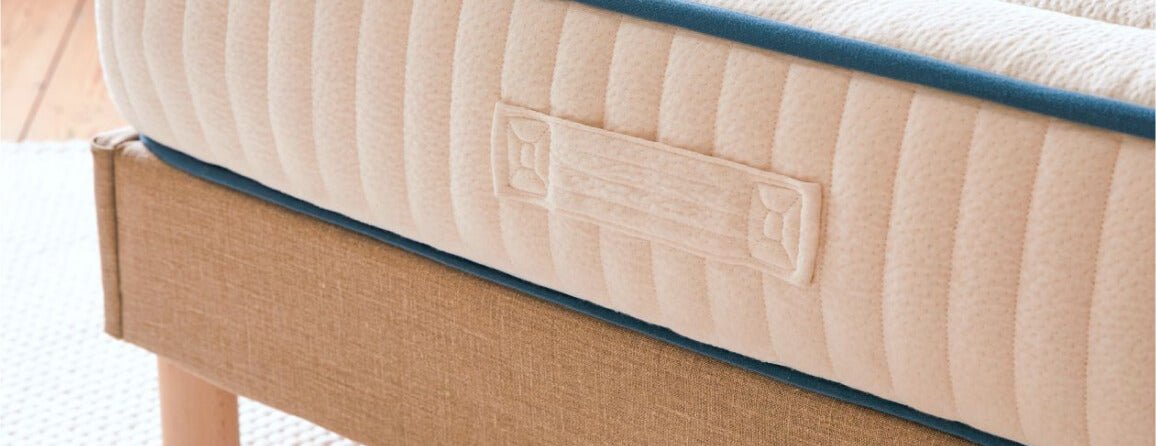
Unlike foam or spring mattresses, natural latex mattresses are very popular. They provide a firm sleeping surface, ideal for those with back issues. Be sure to choose a model with a sufficiently thick latex core. Latex mattresses are often thinner than foam or spring mattresses, but they should still be at least 18 cm thick to provide excellent comfort.At Kipli, a specialist in 100% natural latex, you’ll find high-quality mattresses that combine breathability, durability, and adaptability to your body’s contours. The various models are handmade in Italy and combine natural latex with organic cotton for healthy comfort and restful sleep. At 22 cm thick, they rank among the best options on the market. Crafted with artisanal quality, the Kipli latex mattress offers an excellent alternative to foam or spring mattresses and will delight anyone looking to rediscover deep, natural sleep. And for those who still prefer the comfort of a spring mattress, the KIPLI hybrid mattress combines the qualities of natural latex with the comfortable support of pocket springs. All wrapped in a dry-cleanable cover made of organic cotton and Tencel.
We hope you enjoyed this article on choosing between a latex foam mattress and a spring mattress. Be sure to check out our article to help you decide between a latex or Bultex mattress.
Of course,
Kipli Team