

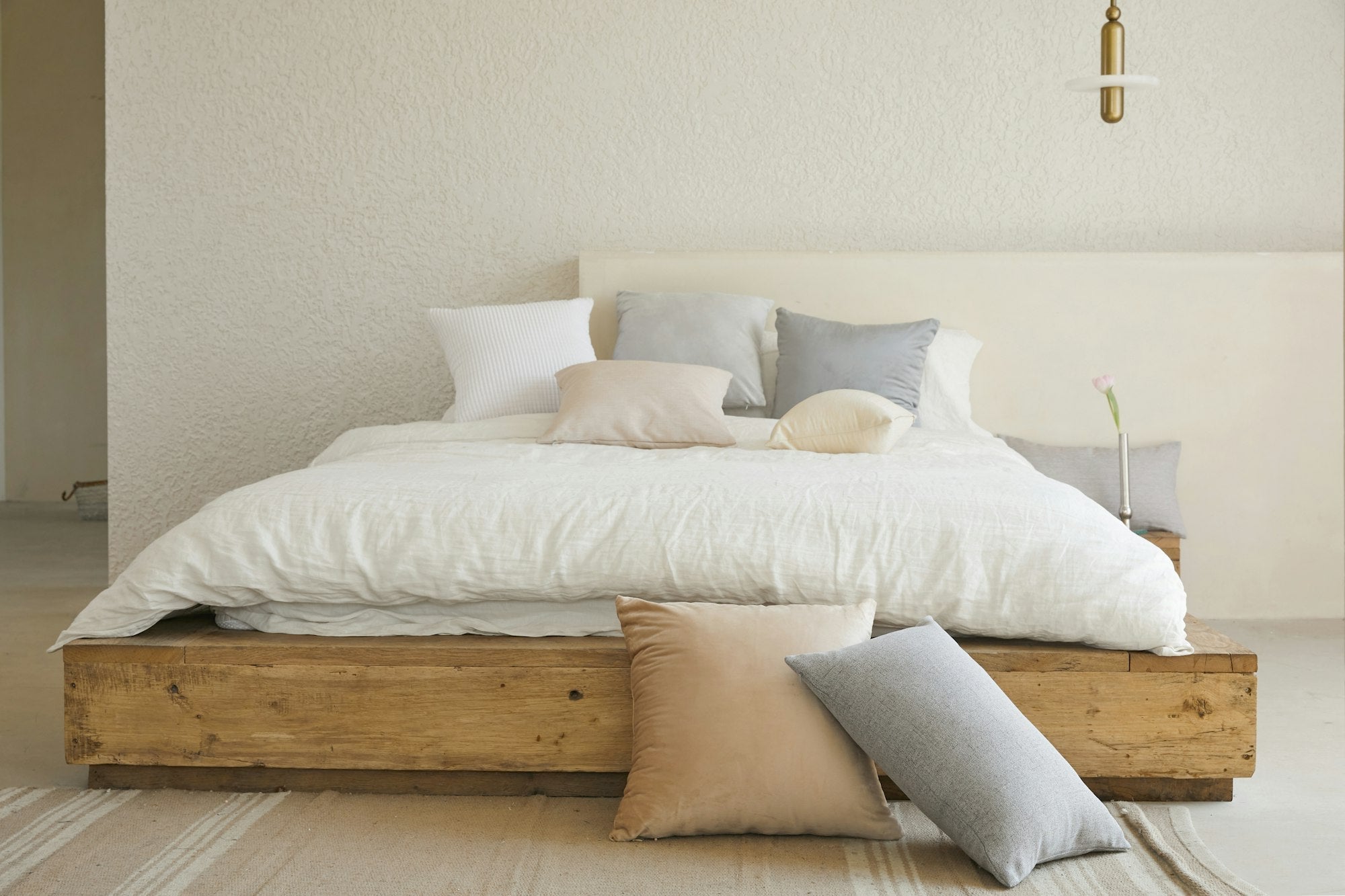
The bed is a place where we spend a large part of our time. It allows us to rest and recharge. But it must provide the comfort we’re looking for. A bed consists of several parts: the mattress, box spring, bed frame, and headboard. It’s essential that these components work well together to support good health and promote restful sleep. Everyone has different needs—whether they’re an adult or a child, tall or short, allergic to dust mites, or suffering from back pain.
In addition to a mattress guide, here is a guide to choosing bedding based on your individual needs—whether it’s your age, body type, or even your decorating preferences. We’re here to help.
The platform bed
A platform bed is a type of bed frame that supports a mattress without a box spring. What sets it apart from traditional beds is how close it is to the floor. It does not require a box spring and is extremely comfortable and durable. There are several types:
- solid platform;
- floating platform;
- storage platform;
- platform with a head and a foot.
One of the main advantages of a platform bed is that it can provide additional storage space. In fact, it often comes with drawers. However, we’re also seeing more and more wooden platform beds with open, visible storage. Some people use them as bookshelves, for example, which adds a certain charm to the room.
A platform bed is therefore ideal for small bedrooms that don't have much storage space: it's an excellent option for maximizing space. To give the bedroom a more modern look, a platform bed can also feature a headboard and footboard.
Platform beds come in a variety of materials, but wood is highly recommended. For one thing, they are versatile and can be incorporated into many different decor styles, whether vintage, rustic, or modern. But wood is best known for its sturdiness and durability.
The Low Bed
There are good reasons to choose a low bed, whether for comfort or aesthetics:
- It's ideal for small rooms: its minimalist design makes the room appear larger than it actually is;
- Made of wood, it's visually stunning, gives off a modern vibe, and can even evoke traditional Japanese style.
Keep in mind that the box spring isn’t the only factor affecting the height—the mattress also plays a role. It’s therefore best to choose a mattress that isn’t too thick. Inner-spring mattresses are often thicker than foam mattresses. A low bed should be avoided by people with back problems, since getting out of bed can quickly become tiring. It’s a good option for young people and those who are shorter in stature.
The Oak Bed
An oak bed is, above all, a sustainable choice. We recommend choosing PEFC-certified French oak for a local and eco-friendly product. The criteria for choosing an oak bed are:
- Dimensions: These depend on the room's floor area and the user's size (child or adult). Naturally, the larger it is, the more comfortable it will be;
- Sleeping height: This corresponds to the depth of the bed and should be chosen based on the type of mattress you plan to use. If the mattress and box spring aren’t a good match, you won’t be comfortable;
- Choosing a model: Oak ensures comfort and durability and is available in several styles. The choice of model should be based not only on personal taste but also on specific needs. A bunk bed for a shared bedroom, a bed with storage or drawers for extra storage space, a low bed for small rooms, etc.
The Zen Bed
We spend a lot of time in our bedrooms, often to unwind and relax. Choosing a Zen-style bed can help create that soothing atmosphere. What is a Zen-style bed, and how do you choose the right one?
The Zen bed is a centerpiece of Japanese interiors, recognizable by its soft, clean-lined design. However, it comes in many styles: wooden platform beds, round beds, beds placed directly on the floor, and more. Paired with soft-colored linens, it’s perfect for creating a relaxing atmosphere. To choose the right one, keep the following in mind:
- Size: The bed should be large enough so that the person or people sleeping in it have enough room to sleep comfortably, taking into account their movements. The most common size for one or two people is a 140 x 190 cm mattress. If the room allows, 180 x 200 cm mattresses provide even more space and comfort. Depending on the available space in the bedroom, you can also adjust the dimensions of the bed frame or tatami mat: they can actually extend beyond the size of the mattress to help furnish a large room or define the sleeping area as effectively as possible;
- When it comes to colors and style: wood is the best option; all you have to do is choose the type of wood. Some woods are lighter, such as poplar, while others are known for their dark hue, such as oak;
- The quality of the mattress: It is recommended to choose a futon, which isn't very thick, or natural latex. The important thing is to find a mattress that doesn't release any harmful substances.

Choosing a Bed Based on the Mattress
A bed frame is, first and foremost, the support on which the mattress rests. To ensure optimal comfort, it’s essential that the bed frame and mattress are compatible with each other. So, what type of bed should you choose based on your mattress?
Of course, the dimensions andthickness of the mattress cannot be overlooked. If a box spring is too large for a mattress, the bed will inevitably be less comfortable. Similarly, a box spring that is too small for a mattress will result in a lack of stability and could be dangerous. Beyond these two factors, the mattress’s technology is also very important.
Wooden slatted bed frames and foam and latex mattresses are a good combination. Spring bed frames are compatible only with spring mattresses.
Choosing a Bed Based on the Mattress Base
For a good night’s sleep, choosing the right mattress is just as important as choosing the right box spring. What type of bed should you choose based on your box spring? Some combinations work better than others, and some should be avoided at all costs.
For spring bed frames, the most suitable mattress is still a spring mattress. In this case, there are several types of springs: biconical springs and pocket springs. It is recommended to choose the same type of springs; otherwise , back pain may develop. For a Tappisier bed frame with flexible or fixed slats, it is recommended to choose a natural latex mattress, which is considered a high-end option. Foam mattresses are generally less expensive, but their quality is not comparable to that of natural latex.
A bed suited to one's body type
Many people sleep in a bed that isn’t suited to their body type. In such cases, even the highest-end mattress won’t be able to provide them with optimal comfort. Here are the key factors to consider when choosing a bed based on your body type:
- Body type helps determine the minimum width that should be preferred;
- The size determines the length of the bed you should choose. We generally recommend a mattress that is 20 cm longer so that your feet don't hang off the end;
- Body weight determines the ideal type of support and level of firmness. The key is to keep the spine aligned throughout the night. Mattresses that are too firm are not recommended for lighter individuals. Conversely, the heavier a person is, the more support their body needs.
The Best Children's Beds
A child’s first real bed is a major milestone. To ensure safety and comfort, parents need to know how to make the right choice. It’s important to provide a child with bedding that’s appropriate for their age, size, and the size of their room. Here are some guidelines on what type of bed to choose for a child:
- The height of the bed should be chosen based on the child's age and height. It is recommended that loft beds be reserved for children over 6 years old;
- It may be a good idea to choose a bunk bed if children are sharing a small bedroom;
- A loft bed is ideal for older school-age children, as it allows them to set up a desk underneath so they can do their homework;
- It's best to choose natural materials: solid wood for the bed frame and an organic cotton mattress, for example.

Choosing the Right Designer Bed
A designer bed must offer a certain level of comfort, but it also serves as a decorative element. It consists of a mattress, a box spring, and a headboard. When choosing a designer bed, you should therefore select these three components carefully to ensure the bed is a good fit for the bedroom. To choose the right one, simply follow a few simple steps.
- Decide on the style you want for the bedroom: contemporary, baroque, bohemian, or Scandinavian, for example.
- Measure the available space while thinking about the layout, which will help you choose the type of bed (single, double, or king-size).
- Identify the features you want: designer beds can also provide storage, whether in the form of drawers or a headboard with shelves.
- Consider the materials: To ensure a good night’s sleep and protect your health, it’s recommended to choose solid wood or wood treated without harmful chemicals, or hypoallergenic fabrics.
A designer bed is both an investment and a very personal item, so it's important to consider all these factors beforehand.
We recommend these other pages: