

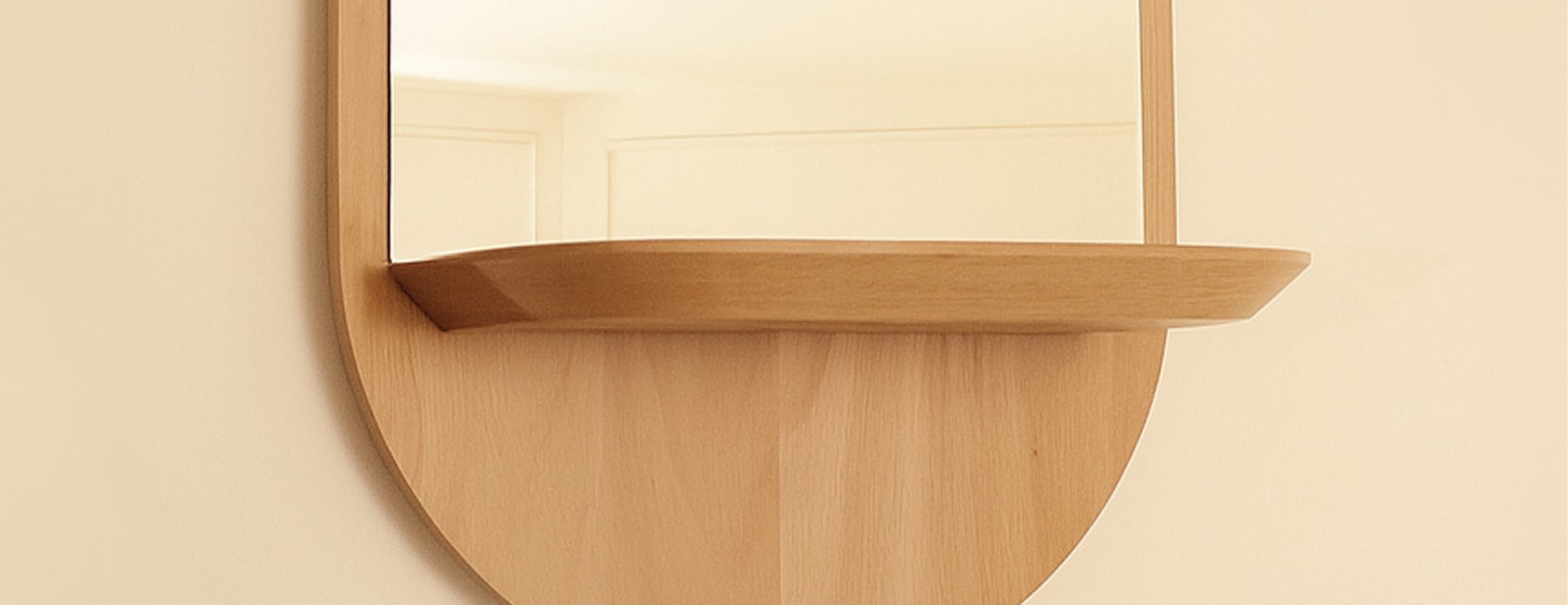
How do you choose between a wall-mounted mirror and a freestanding mirror?
Choosing the right small decorative accents depends as much on the overall atmosphere of the room as it does on the homeowner’s good taste in interior design. A decor style can even be enhanced by leaving out these elements. It’s all about balance.
Among the decorative items found in a home, mirrors have always held a special place, as they are interior design elements that combine decorative appeal with practical function.
First, we’ll explore what a mirror is and, more importantly, the different types that exist. At the same time, we’ll identify the rooms where such an item can be placed, and then examine the key differences between a freestanding mirror and a wall-mounted mirror. Finally, we’ll conclude by discussing the unique characteristics of mirrors and their limitations, to better understand what makes them appealing—but also what we need to be mindful of.

The Composition of a Mirror
A classic mirror consists of a stack of layers of material. Starting from the front surface toward the wall, the layers are as follows:
- the frame (often made of wood or metal), if there is one—though this is not necessary for all mirrors;
- glass (varying in thickness, texture, and finish);
- a layer of aluminum or silver to reflect light;
- a layer of copper or lead (known as the "tain"), which makes the mirror opaque and prevents the aluminum layer from oxidizing;
- an additional back cover layer made of various materials;
- a wall-mounting system, if necessary.
It is, therefore, a collection of materials that have the ability to reflect ambient light, thereby creating a dual visual impression for the observer. By adjusting certain properties of these materials, one can achieve a specific style or effect (one-way mirror, magnifying effect, etc.).
The Different Types of Mirrors
Without delving into the ancient history of mirrors, which date back more than 6,000 years before our era, we should nevertheless recall why humanity has used mirrors. The mirror has, over time, alternately become a symbol of luxury and wealth (silver nitrate was used in their manufacture at a time when this mineral was rare), then became more widely available, evolving into a decorative and aesthetic accessory, and finally into a practical item (particularly in the bathroom).
There are, therefore, as many types of mirrors as there are uses for this object. A mirror can take the following forms:
- as a decorative, designer piece of furniture in a home;
- as a component of a wall or ceiling (large, non-structural assembled mirrors);
- a practical item in a bedroom or living room for adjusting one's outfit;
- as a paramedical or hygiene item to facilitate personal grooming and hygiene (e.g., a magnifying mirror for applying makeup);
- as a scientific mirror (such as those used in telescopes);
- etc.
As for shapes, there are no restrictions. Of course, this depends on the manufacturers’ production capabilities, but almost anything is possible: round, square, rectangular, irregular, wavy, and so on. Depending on where the mirror will be used (outdoors, in the bathroom, in the living room, etc.), special treatments can be applied to ensure it remains in good condition over time.
Choosing Between a Freestanding Mirror and a Wall-Mounted Mirror
There are many different types of mirrors, but two types are used quite commonly.
The freestanding mirror
As its name suggests, a freestanding mirror is a mirror and stand set that does not require wall mounting. It is typically mounted on a stand (usually made of wood or metal) that allows it to stand upright. Because it is small, it can be placed on a piece of furniture, either as a decorative accent or for practical purposes.
It can also be floor-standing. This type of freestanding mirror is typically found in a bedroom, so that occupants can assess their appearance from head to toe and compare their outfits. Because it stands alone and can be moved, it can be compared to a piece of furniture. However, this mirror requires a significant amount of space, as you need to be able to walk in front of it and have enough distance to see your reflection clearly.
The wall mirror
Often installed in a room designed for practical use (such as the bathroom), a wall mirror is flat and thin. Whether framed or unframed, it must be mounted on the wall using a mounting system appropriate for the type of mounting hardware and the type of wall on which it is installed:
- "ice screw" type fasteners on wood or drywall;
- Installation using anchors in a concrete, cinder block, or brick wall.
It reflects the image of the person getting ready in the bathroom, while adding a touch of style to the bathroom decor. Often installed at the top of a wall (so it is at eye level), it is usually located above the sinks and basins. Its ability to reflect light also helps brighten the room.
That is why mirrors also have a role to play in other rooms of the house. For example, a wall mirror in an entryway not only allows you to take one last look at your appearance before heading out, but it also helps make this typically small space appear larger.
It’s worth noting that wall mirrors are not considered furniture, but rather decorative elements—whether they’re useful or not. They cannot be moved easily, unless you take them down and install new mountings at the chosen location. However, they do not hinder movement or passage through the rooms of the house in any way.
The Limits of Mirrors
A mirror is an object that is as classic as it is captivating. It always catches a visitor’s eye, even though it has long been widespread and even commonplace. Yet mirrors have their own limitations.
- Unless you prefer a specially designed travel mirror, it's difficult to carry a mirror around because it's so fragile due to its glass surface.
- Aluminum-coated mirrors can sometimes oxidize in damp rooms, causing unsightly flaking to appear along their edges.
- The prices of mirrors can sometimes be quite high. This depends on their build quality, as well as the type of design (built-in lighting, anti-fog feature, etc.) and size.
But mirrors are also decorative items, which is why they come in so many different styles and options. In addition to their practical uses, they can help brighten a room or make it appear larger. That’s why the ideal choice depends on a number of factors that must be considered to find the right balance between the room’s layout and the person’s interior design preferences.
We recommend these other pages:
- Why Choose an Asymmetrical Mirror for Your Interior Design?
- How do you choose a unique mirror?
- What are some good reasons to use candles in interior design?
-
How can you use a decorative candle to enhance your home décor?
- How do you choose a natural candle for your decor?
- How can you create a unique decoration using a clear vase?
- How can you create a unique arrangement using a single-flower vase?
- How do you choose a wooden picture frame for a unique decor?