


According to the DAK Health Report, 75% of all working people in Germany suffered from back pain in 2017. The most common causes are poor posture while sitting and stress. However, many people also complain of back pain after sleeping, which subsides as the day goes on. But what causes nighttime or morning back pain, and what can you do about it?
Back Pain After Sleeping
Back pain prevents us from sleeping well and causes pain after waking up. Sometimes back problems persist throughout the day and drain your energy! Back pain after sleeping can have various causes and isn’t necessarily due to an improper sleeping position. We’ve summarized the most common causes for you.
Back pain is a common problem, and its causes vary widely. The main causes include improper bedding, muscle tension, and poor sleeping posture, but serious issues such as medical conditions can also be responsible for back pain after sleeping.

The Best Sleeping Position for Back Pain
The correct sleeping position is essential for restful sleep, as an incorrect sleeping position can cause pain. Proper posture while sleeping is therefore important for reducing joint and muscle problems. From an ergonomic standpoint, it is advisable to sleep on your side or on your back. People who sleep on their stomachs often struggle with back pain, as sleeping on the stomach causes the lower back to arch. It is advisable to sleep on your back or side and to avoid sleeping on your stomach.
Always make sure your spine forms a straight line. Your mattress should allow you to sink in slightly at the hips and shoulders. Your pillow should support your neck and head so that your cervical vertebrae do not bend. Doctors and physical therapists recommend natural latex mattresses for back problems. Natural latex mattresses are known for their excellent point elasticity, which allows heavier parts of your body to sink in comfortably while the rest of your body receives optimal support. When purchasing a natural latex mattress, however, be sure to check its exact material composition. Many manufacturers mix natural latex with synthetic latex to save on raw material costs. Synthetic latex mattresses, however, do not offer the same beneficial sleeping properties as 100% natural latex mattresses. Online retailers such as Kipli offer 100% natural latex mattresses that can combat or at least alleviate back pain.
Back sleepers
Do you sleep on your back? If so, you can rest easy, since sleeping on your back is recommended from an ergonomic standpoint. If you still experience back pain after sleeping, you can also place a small pillow under your knees. This supports the lower back. You should also choose the right pillow, one that provides optimal support for your neck and head and keeps your entire spine in its natural position. With these simple tips, you can optimize your sleeping position and help prevent back pain.
Side Sleeper
Do you mostly sleep on your side and experience back pain at night? We recommend pulling your knees closer to your stomach. This position helps alleviate the pain. You should also place a pillow between your knees to keep your pelvis aligned and relieve pressure on your spine. For your head, choose a neck support pillow that is neither too flat nor too high and keeps your head in a straight line with your neck.
Stomach sleeper
Whenever possible, you should generally avoid sleeping on your stomach. From an ergonomic standpoint, this sleeping position is not recommended. When you sleep on your stomach, your spine curves inward, which can cause back pain after sleeping. If, despite this, you are unable to break the habit of sleeping on your stomach, you can place a flat pillow under your stomach to prevent this inward curve.
Choosing the Right Bedding to Prevent Back Pain After Sleeping
In addition to sleeping in the right position, nighttime back pain can also be alleviated by choosing the right bedding.
Choosing the Right Mattress
The right mattress is key to a good, pain-free night’s sleep. Back pain can often be cured—or at least alleviated—by choosing the right mattress and box spring. In general, we recommend natural latex mattresses above all else for back pain. These are recommended by doctors and physical therapists because of their exceptionally high elasticity. Unfortunately, due to their high quality, natural latex mattresses aren’t exactly cheap. However, various online retailers, such as Kipli, offer these high-quality mattresses at a fair price, allow you to pay in installments with no fees, and provide a trial period during which you can try out the mattress for free. To make the right choice if you have back problems, you should consider the following points in addition to the choice of material:
The Right Firmness Level: We would like to challenge the common belief that you should choose a very firm mattress if you have back pain. Your mattress should be firm and provide good support. At the same time, however, it’s important that it not be too firm. In fact, moving and turning during the night on a mattress that’s too firm can actually worsen your pain. A density between 60 and 85 kg/m³ with a medium firmness level is ideal for ensuring adequate support and good comfort. However, you should choose the firmness level based on your body type. Feel free to message us via chat for a detailed consultation.
Support Zones: For optimal comfort, you should consider a mattress’s support zones when making your selection. Support zones are designed to allow specific parts of the body to sink in just the right way. Mattresses with 7 comfort zones are considered the most popular, as they are suitable for the needs of 90% of all people. With a symmetrical arrangement of the comfort zones, you can regularly rotate the mattress lengthwise to ensure even wear. Depending on the material you choose for your mattress, comfort zones are highly recommended for a good night’s sleep. With certain mattresses, such as natural latex mattresses, however, comfort zones are not absolutely necessary. Due to the high point elasticity of natural latex mattresses, they adapt perfectly to your body.
Choosing the Right Material: If you experience back pain after sleeping, the material composition of your mattress is also important. Natural latex mattresses are particularly popular because of their point elasticity. The material provides perfect support while allowing you to sink in exactly where needed. Natural latex mattresses thus support the natural curvature of your spine.
Replacing Your Mattress: Have you been unable to find a comfortable sleeping position on your mattress for some time now, and do you wake up in the morning with back pain? A worn-out, sagging mattress may be to blame. A good indicator of whether you should replace your mattress is its density. Lightweight foam mattresses can have a low density of between 20 and 25. These need to be replaced after just one to two years. Synthetic mattresses with a density of 30 also wear out within two to three years. With a density of 35, your mattress will last about five years, and with a density of 40, you can use it for six to eight years. Mattresses with a density between 50 and 60 can be used for 10 years. High-quality natural latex mattresses, such as the Kipli mattress, are among the most durable mattresses available. With a density of over 75, you can comfortably sleep on such a mattress for up to 15 years.
Which pillow should I choose?
Choosing the right pillow is crucial and depends largely on your preferred sleeping position. If you want a versatile pillow, choose one that is 10 to 15 cm high. If you sleep on your side or back, the pillow should fill the space under your head to ensure your neck is in the ideal position. If you sleep on your stomach, your pillow should be as flat as possible. It is also recommended that stomach sleepers not use a pillow at all.
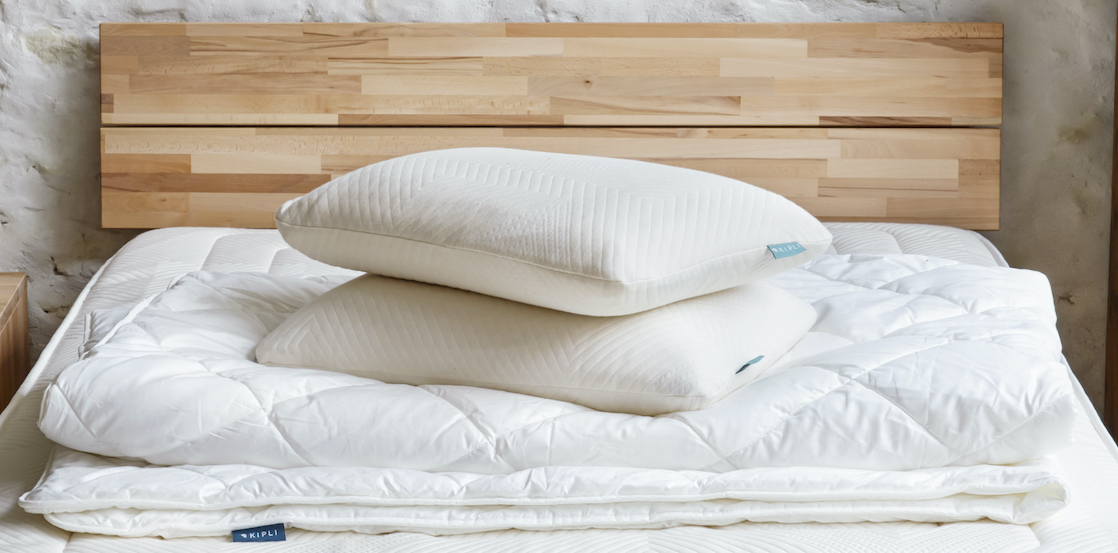
The Kipli pillow has an average height of 12.5 cm. This natural latex pillow was designed to accommodate any sleeping position. It is ergonomic and tapered at the edges, providing optimal support for your neck in any sleeping position.
The Right Slatted Bed Base
The choice of slatted frame also plays an important role in achieving the optimal sleeping position, as it affects the sleeping experience by up to 40%. You essentially have a choice between three types of slatted frames: the classic slatted frame, the bentwood frame, and the disc-style slatted frame. Each slatted frame has its own unique features and adapts to individual needs and preferences to a greater or lesser extent.
Classic slatted frames with fixed slats are a good choice for people with back problems due to their relatively high firmness. The type of slats and their width allow you to adjust the flexibility. For a softer feel, choose flexible slats. Choose firm slats for greater support. The number of slats also plays an important role in providing support. The more slats you choose, the more support your slatted base will provide. It should have at least 16 slats. A slatted base with covered slats offers not only aesthetic appeal but also even and relatively firm support, comparable to that of rigid slats.
Disc-style slat beds are also known as “relax slat beds” because of their load-bearing capacity and comfort. The discs rotate independently of one another, allowing for a high degree of mobility. Disc-style slat beds are recommended for people with back problems.
Spring slat bases provide minimal support and therefore do not offer optimal stability. If you want to avoid soft surfaces, we do not recommend this type of slat base.
We hope our tips will help relieve your back pain. You can find more tips for managing pain in the Health Center. If you have any questions, feel free to contact us via chat or email at kontakt@kipli.com!
```