

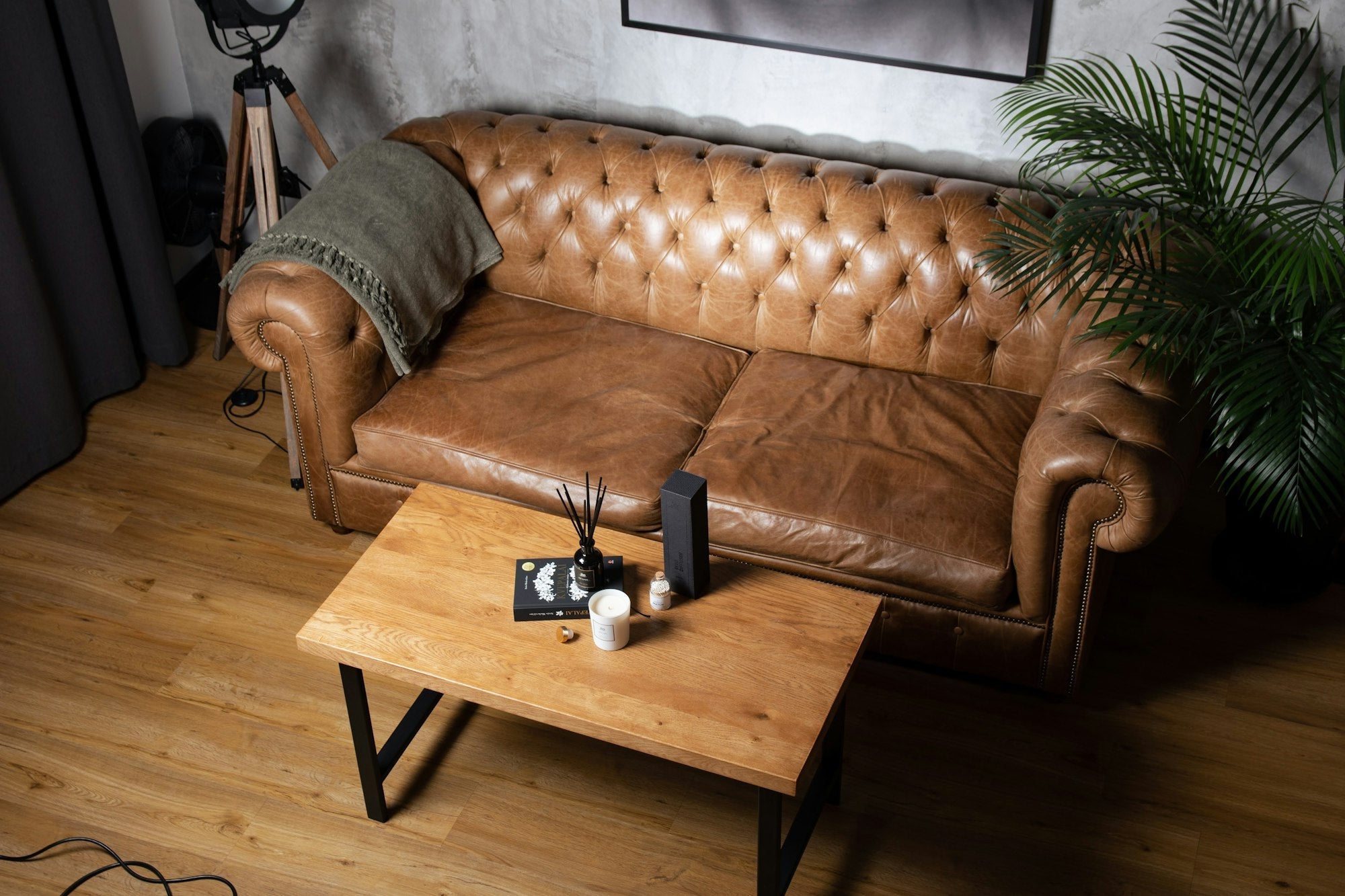
Leather is a material that requires special care and regular maintenance to ensure its optimal longevity. When it comes to a leather armchair or sofa, this maintenance becomes essential due to the heavy use it undergoes in daily life, wear and tear, and changes in the leather’s elasticity.
Since a leather sofa is difficult to transport to a professional, its care is usually the responsibility of the owner, who generally seeks out the best products and tips for maintaining the sofa while avoiding irreparable mistakes—of which there are, unfortunately, many.
We’d like to offer you an overview of effective techniques and products for conditioning, cleaning, degreasing, or restoring a leather sofa.

How do you clean a leather sofa, and what product should you use?
Cleaning a leather sofa may be necessary to quickly mitigate the effects of a fresh stain on its surface, but it’s also part of regular maintenance. In fact, a deep cleaning is recommended once a month for light-colored leather sofas and once every two months for dark-colored ones.
What should I use to clean a grease stain off a leather sofa?
It can happen that you spill something greasy on a leather sofa. The most important thing in such cases is to act quickly, but take a few precautions so the situation doesn't get worse.
First, it is recommended to sprinkle a generous amount of talcum powder on the greasy stain, then let it sit for about an hour. Next, remove the talcum powder with a soft cloth, and repeat the process if even the slightest trace of grease remains.
Once the stain is gone, it’s best to immediately perform a deep cleaning—which we’ll discuss later—to even out the color of the leather and prevent a “clean spot” from appearing that stands out too much compared to the rest of the sofa’s surface.
Cleaning Other Types of Stains on a Leather Sofa
The list of substances that can stain leather is, unfortunately, very long. In fact, there are also countless tips and tricks recommending the use of a wide variety of products for every type of stain. However, when faced with the urgency of cleaning up a stain—whatever it may be—it’s difficult to figure out exactly which product to use, and it’s even more unrealistic to expect to have all these products on hand at all times.
So, is there a universal product you should always have on hand to act quickly? According to leather care experts, if you had to choose just one product to use on stains other than grease stains, it would be agate stone.
Clay stone is a natural, chemical-free product that does not damage the hands of the person applying it and respects the unique characteristics of leather, which is a living material that changes over time.
To use the clay bar, place it on a very slightly damp cloth and gently apply it to the stain. The goal is to let the product work without rubbing too hard, which could damage the surface—especially in the case of delicate leather. Cleaning should therefore be done by dabbing the stain—even when it is deeply embedded—without trying to remove it by rubbing, which could leave marks.
It is also important to note that the soft cloth used should be damp, but not soaked in water, because too much water can damage the leather.
Routine Cleaning of a Leather Sofa
Whether it’s stained or not, cracked or not, new or old, a leather sofa needs to be cleaned regularly to maintain its luster and suppleness. It’s therefore essential to care for it—more or less frequently depending on its color and how it ages over time.
Which product should you choose to care for a leather sofa?
Many products have proven effective for the regular care of leather sofas.
Let's start with everyday, non-specialized products that are suitable for gentle cleaning, which are as follows:
- Glycerin soap: Can be used as a spray or applied to a washcloth or towel. Spray or apply the soap section by section, then dry each section with a soft cloth without rinsing with water. Allow the leather to air dry without exposing it to heat, which could cause it to crack or shrink. Finish cleaning by gently buffing the leather with a clean cloth using circular motions;
- Cleansing milk and white vinegar: Start by soaking a cotton cloth in cleansing milk, then add a few drops of white vinegar. Wipe the cloth over the leather, let it sit for a few minutes, then buff the surface with a clean cloth rolled into a ball;
- Marseille soap: Start by thoroughly dusting the sofa, then gently scrub it with a slightly damp, soapy cloth. Once the sofa is clean, use a damp sponge to remove all traces of Marseille soap, then let it air dry without using heat to speed up the process.
How do you clean a very dirty leather sofa?
When the situation calls for it—particularly when the maintenance of a leather sofa has been neglected for several months or years—it is essential to use stronger products specifically designed for leather care. Whether they are called “degreasing lotion” or “special leather shampoo,” these products were originally intended for the care and cleaning of horse saddles.
Available at specialty stores or sporting goods stores, they come with instructions for use that must be followed carefully. When using a cleaning product for the first time, it is advisable to apply it to a hidden area of the sofa so you can observe the reaction before using it on the entire surface. In fact, the product may sometimes have too strong an effect that could alter the color of the leather—which isn’t a big deal for a saddle, but is much more of a problem for a sofa.
What product should I use to condition leather?
After cleaning a leather sofa, it’s always best to apply a conditioning product to help prevent cracking and splitting. In this regard, moisturizing makeup remover and baby cleansing lotion have proven to be highly effective—and at a very reasonable price.
These products are best used with a washcloth; simply apply them gently to the surface of the sofa in small dabs, always taking care not to rub too vigorously. Finish the nourishing treatment by wiping the surface with a soft cloth using broad circular motions.
If you have a leather sofa that is already cracked, it may be worth trying to apply vegetable glycerin to the affected areas.
We recommend these other pages: