

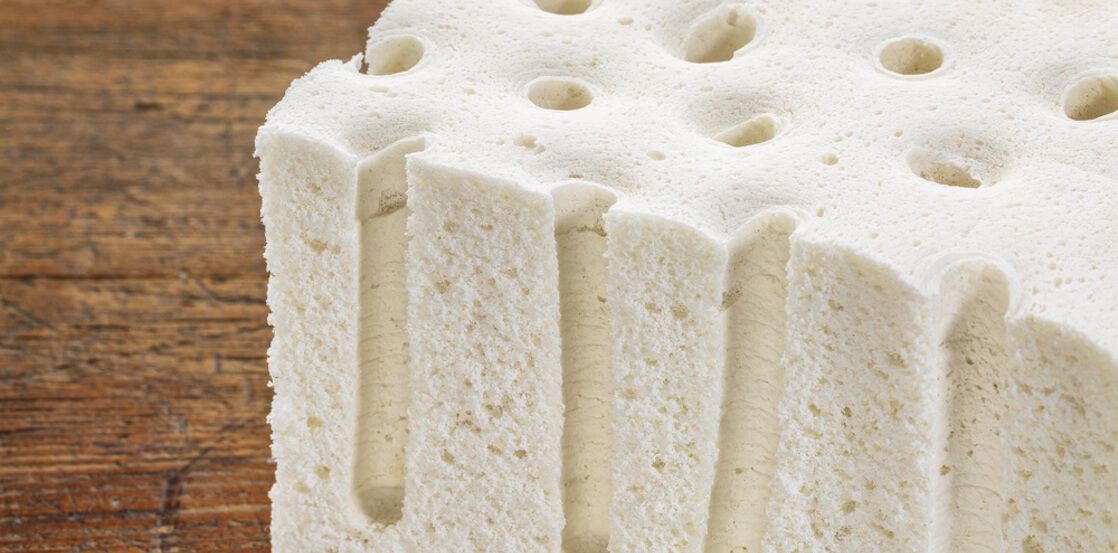
Learn all about the core of the Kipli mattress
IN SEARCH OF THE SOUL OF THE KIPLI MATTRESS
The inner part of a mattress—the core inside the cover—is called the “soul” in technical terms. The search for the core in this case is not a philosophical concept but rather a family story—that of Davide, the founder of Kipli. His uncle Mario, after working for years at Pirelli in the production of (synthetic) latex mattresses, decided the time had come to pursue his dream: to produce a natural core for use in mattresses. The material that fascinated him was natural latex. Hepersuaded a group of people to finance the first factory and launched one of the first production lines for natural latex cores in Europe in 1998. The choice of the Kipli mattress core has deep roots—it stems from family history and a conviction that goes against the grain . Today, 90% of mattresses produced in Europe have a synthetic foam core (primarily polyurethane).Just like polyester, this plastic derivative can be marketed under various catchy names such as “high-resilience foam,” “comfort foam,” and others. These materials are neither eco-friendly nor sustainable. In light of the ecological and climate crisis we are currently facing, we believe that our consumer choices must take at least three fundamental aspects into account:
- People's Health and Well-Being
- Ecology and Respect for the Planet
- A price that takes negative externalities into account. These are the three founding principles of Kipli and of all the products we develop.

0% POLYURETHANE, 0% PLASTIC
Sleeping on a polyurethane core—a type of plastic—doesn’t seem like a good idea at first glance. Yet 90% of the mattresses sold today are made with it.Promising magical nights on polyurethane is certainly appealing to those who produce it, since polyurethane has characteristics that are perfect for a manufacturer—especially when paired with a dash of marketing.
- Polyurethane costs one-fourth as much as natural latex.
- Polyurethane weighs about half as much as natural materials.
- Polyurethane can be stored in rolls for a very long time.
- Polyurethane can be cut with millimeter precision.
- Polyurethane can be shaped into any desired form.
- It can be purchased in rolls and doesn't require a large initial investment in equipment.But there's a problem. You shouldn't sleep on polyurethane.
- Polyurethane is made from two main chemical components: toluene diisocyanate (TDI) and methylene diphenyl diisocyanate. These two components are mixed with water, polyols, and catalysts such as dibutylne (TBD) to trigger the chemical reaction necessary for the formation of polyurethane foam. Polyols are substances produced by a chemical reaction involving propylene oxide (methyloxirane).
- Polyurethane is a highly flammable material and must therefore often be treated with flame retardants ( which are chemicals that may be toxic).
- Toluene diisocyanate (TDI) has been recognized as a carcinogen by the U.S. Centers for Disease Control and Prevention.
- Toluene diisocyanate (TDI) and methyloxirane are also listed as toxic substances under the Canadian Environmental Protection Act. Manufacturing facilities that produce polyurethane foam are a major source of a wide range of hazardous air pollutants, including:
- Methylene chloride
- Toluene diisocyanate (TDI)
- Hydrogen cyanide
- Thus, although the final product (the polyurethane foam mattress in this case) does not pose a health risk in and of itself, its production has an impact on those who manufacture it, those who live near the factories where it is made, and anyone else exposed to these chemicals through air and water pollution.Often, the layers of polyurethane that make up the cores are bonded together with chemical adhesives.From an environmental standpoint, polyurethane is not a good idea:
- It takes 500 years to decompose
- Its resilience is lower than that of some natural materials ( so the mattress has a shorter lifespan)
- It is produced exclusively from non-renewable fossil fuels, which requires a large amount of energy. From the perspective of your comfort:
- Polyurethane, like many plastics we are familiar with, is not breathable and tends to trap heat.
- It tends to warp relatively quickly and is less durable than some natural materials.
0% FLAME RETARDANTS
As with the lining of our mattresses, flame retardants should be avoided in the core. These chemical treatments are used to reduce the flammability of materials and are frequently used in combination with polyurethane, which, like all plastics, has a high flammability rating.
0 COV
Have you ever wondered what that strange smell is when you unroll or unpack a new mattress? That smell may indicate the presence of volatile organic compounds (VOCs), including a pungent mixture of flame retardants and other chemicals. Many VOCs are also odorless. VOCs, many of which are classified as carcinogens, are emitted as breathable gases from mattresses, carpets, furniture, paints, cleaning products, printer ink, and other household items. Concentrations inside the home can be ten times higher than outdoors. Considering that we spend an average of 7 to 9 hours a night with our bodies in close contact with the mattress, this problem cannot be underestimated.Although manufacturers claim that the polyols and isocyanates in mattress foam have reacted and are no longer volatile, polyurethane foam mattresses can release VOCs after a few years as the foam tends to break down or crumble.

100% NATURAL MATERIALS
At Kipli, we naturally prefer and recommend natural materials for the core of a mattress. The 100% natural materials that can be used for the core include natural latex, wool, and cotton. Of the three natural materials mentioned above, natural latex is one of the most commonly used in mattress production.
The benefits of natural latex are:
- Very high comfort
- Highly Breathable Features
- Freeof toxic substances and chemical treatments
- Renewable and biodegradable material
- Minimal maintenance
- Superior durability compared to any synthetic material and about twice that of polyurethane. For more information on natural materials, please read the section titled "The Story of Our Soul."
PLACE OF MANUFACTURE
The location where the mattress core is manufactured is also an important factor. This is where the warranties related to the manufacturing process apply. This applies equally to the core of a synthetic polyurethane mattress and to the core of a natural mattress, such as one made of natural latex.An example will clarify this better than a long explanation: The core of a natural latex mattress must undergo a process called“vulcanization,” which involves transforming liquid natural latex into a solid core. This process is delicate and requires meticulous monitoring to prevent any contamination by chemicals, thereby preserving the core’s natural characteristics.This process can be carried out directly in the countries where natural latex is produced—namely, in Southeast Asia—and then imported into Europe as finished natural latex cores, or it can be carried out in Europe by importing liquid natural latex by sea.It goes without saying that European regulations are much stricter, more rigorous, and better enforced than those applied in natural latex-producing countries, both in terms of production quality and respect for workers. Furthermore, the drying process—which is the final step—is carried out more thoroughly in Europe (the core is dried on both sides, using both heat and infrared). Improper drying can result in a lingering odor and durability issues.

BASIC CERTIFICATIONS
Excluding polyurethane automatically removes memory foam mattresses, polyurethane mattresses, and the majority of pocket-coil mattresses from our checklist (this type of mattress also contains polyurethane in the side layers and, in many cases, above the coil layer).Consequently, with the exception of polyurethane, the most common natural alternative is natural latex. There are several key certifications to consider, which guarantee the origin of the latex, the manufacturing process, the absence of chemicals, and sustainability.Here are a few of them:100% NATURAL EUROLATEX: This certification can only be issued by one of three European factories. It guarantees that the core is actually vulcanized in Europe and is not imported. It also guarantees the absence of synthetic latex.In fact, the term “100% natural latex” can be used for products containing as little as 85% natural latex, with the remainder consisting of vulcanizing agents (approximately 3–4%, mainly potassium and zinc oxide) and synthetic foam. It is important to check the actual percentage (approximately 97%) to ensure there is no synthetic foam.
ECO-INSTITUT: This certification guarantees that the core contains no substances or emissions harmful to health. It also guarantees the absence of chemical residues and gas emissions harmful to humans. The tests are conducted rigorously and rule out the presence of numerous potentially toxic substances, including volatile organic compounds (VOCs), persistent organic pollutants, heavy metals, pesticides, phthalates, and formaldehyde.LGA Tested Quality: Awarded by TÜV Rheinland, a world-renowned independent certification body, this certification attests that Kipli products meet the strictest requirements for safety, performance, and durability.
THE PRICE
There are two factors to consider when determining the price of a mattress core. Generally, it amounts to ⅔ to ¾ of the mattress's price.
1. DURABILITY/PRICE The coreis one of the fundamental components of a mattress, and its durability is essential to the mattress’s longevity and comfort over time. Durability must be taken into account to determine whether the listed price is reasonable. A mattress with a natural latex or pocket-spring core typically lasts about twice as long as a polyurethane mattress. If this factor is properly considered during the selection process, it allows for rational decision-making.
2. NEGATIVE EXTERNALITIES In the article on mattress covers, you will find a comprehensive explanation of what negative externalities are. Specifically, when comparing a natural latex mattress to a polyurethane mattress, the main negative externalities that are not factored into the nominal price are as follows:
- Extraction of a non-renewable fossil material versus extraction of a renewable plant-based material
- Core lifespan: 7–9 for polyurethane, 14–16 for natural latex.
- Biodegradability of materials: 500 years for polyurethane, 2 years for natural latex. As with the cover, when considering the sustainability-to-price ratio and negative externalities, the nominal price is misleading when making a responsible choice. The nominal retail price of a natural latex core is about 60% higher than that of a polyurethane sheet. But when factoring in lifespan and negative externalities, the price ratio is reversed.
We hope you enjoyed this article and that it gave you a good overview of the key aspects of what makes a mattress special. We also invite you to read our article on the history of Kipli—and more specifically, the history of the Kipli mattress—from its family heritage to today’s production.
See you soon
The Kipli Team