

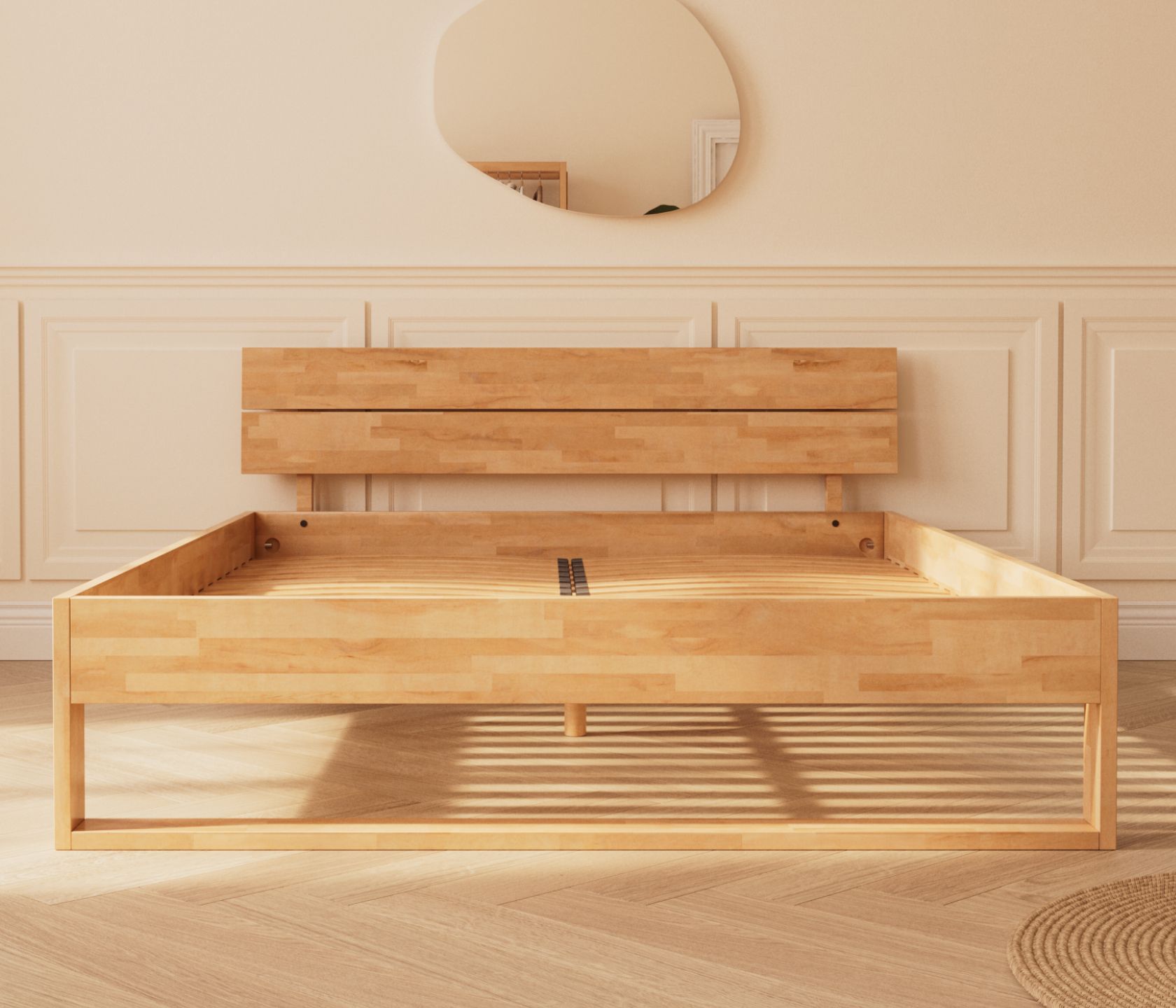
Here's how to choose a box spring for truly comfortable bedding...
On average, we spend 33% of our lives sleeping. Choosing the right bed, therefore, requires careful consideration and thought. The bed and its components, together with the mattress, help us improve our sleep and thus have a direct impact on our lives.
Choosing a box spring can be just as complicated as choosing a mattress, since there are so many models on the market. There are a multitude of factors to consider, starting with size, materials, style, and design—and, of course, your budget. We’ll try to go over the key points to consider when choosing a box spring.
How can you tell if you need a box spring?
Indeed, this is a question worth asking. The first thing that comes to mind is: Do mattresses necessarily need a box spring? The answer is by no means definitive. The reason is that mattresses require a certain type of support to remain in good condition and provide adequate firmness for your body. There’s nothing stopping you from placing your mattress directly on the floor, but a box spring or platform can offer many advantages. It’s entirely possible to put your mattress on the floor or to set up a box spring directly on the floor and place your mattress on top of it, but most often, people choose to place the box spring inside a bed frame to raise the sleeping surface. This makes it easier to get in and out of bed and also improves air circulation. We’ll go into more detail about the benefits in the next section. Your main concern when choosing a box spring should be the support it provides and how it affects your mattress. Also, keep in mind that some mattresses come with compatible box springs. Before you start looking for a bed base to go with your new mattress, keep in mind that many companies now offer one when you purchase your mattress. These bed bases are selected to work specifically with your mattress. For most households, the most common bed bases consist of a set of wooden slats that form a platform. Other bed bases may feature spring box springs. It’s important to keep in mind that the type of box spring you need may vary depending on the nature of your mattress. In general, we recommend slats for the support they provide. Stiff slats provide more firmness, while flexible slats add softness to your sleeping surface. Spring box springs should be avoided, especially with latex or foam mattresses, as they can sag underneath. But we’ll go into more detail about all of this below.
What are the benefits of using a box spring?
-
A. A box spring ensures better hygiene and makes cleaning easier
A box spring raises your mattress off the floor and protects you from pet hair, insects, dust mites, and allergens that may be on your floor. In addition, it prevents your mattress from becoming a breeding ground for mold and moisture, which can cause your bedding to deteriorate rapidly. The bed frame plays a significant role in reducing the risk of respiratory issues, especially if it is made from natural materials. It’s important to note that using a bed frame is crucial for spring mattresses. These mattresses have more internal space, which can promote the growth of dust mites. Even when labeled as breathable, mattresses should be placed on a surface that promotes air circulation. A box spring will allow your mattress to breathe freely, providing greater freshness and, therefore, greater comfort.

-
B. A box spring improves support and extends the life of mattresses
Without a foundation, your mattress will be more prone to sagging and will cause aches and pains that can ruin your sleep. The reason is that mattresses are meant to rest on a foundation, not on the floor, and choosing the wrong box spring as a foundation can prevent you from getting the performance you expect from your bedding. Mattresses also need maintenance. After years of use, your mattress may begin to lose its firmness. Furthermore, without proper support, it could even end up sagging. This is especially true for large beds or memory foam mattresses, as they are more prone to sagging.

What size bed should you choose?
To choose the right bed frame, it’s important to know that each country has its own standard sizes. These therefore vary from one country to another. For example, in France, the standard sizes for a double bed are 160x200 or 180x200. In countries like Germany or the Nordic countries, beds are generally longer than 210 cm. To choose the right box spring, you need to consider the dimensions that fit the space you have available and the features you’re looking for. Be mindful that the bed frame or headboard adds a few centimeters to the final dimensions. It all depends on the room you’re furnishing: a child’s room, an adult’s room, or a room for a couple. If you’re looking for a bed for a couple, it’s best to choose one that’s wide enough for optimal comfort. Ideally, both partners should have enough space to lie down and place their hands behind their necks without touching each other. So, if space allows, opt for a bed that’s at least 160 cm wide. This reduces the likelihood of feeling cramped or disturbing your partner during the night. Another important factor not to be overlooked is the height of the bed. Indeed, you must take into account that, to get in and out of bed safely and comfortably, the bed’s height should be appropriate for the height of the people using it .The total height may vary depending on the height of the legs you choose. As for the length of the bed, it’s generally recommended that it be 10 to 15 cm longer than the height of the person who will be sleeping in it. If there are two of you, you should base your choice on the height of the taller person. So, if you’re 1.70m tall, it’s advisable to choose a bed that’s 180 cm or 200 cm long.As mentioned earlier, another key factor to consider is the available space in the room: you can visualize a mattress on the floor and check that there’s enough space on either side of the bed to move around comfortably. Check out our articles “How to Arrange Your Bedroom to Promote Sleep?" and "Ideas for Designing Your New Bedroom."
What materials should you choose?
When choosing a bed frame, it’s important to know that there are various types of materials used in bed manufacturing. Wood is the oldest of these materials and has been used in bed manufacturing since the 14th century. Starting in the 19th century, beds began to be made of metal and aluminum to address the problem of high humidity in homes at the time, which led to insect infestations in wood. Today, both materials are used without any drawbacks.Here are a few points to keep in mind when choosing a material: In terms of durability, a wooden or metal bed offers more or less the same performance today. Of course, metal may seem more durable than wood. However, this is not the case when it comes to solid wood. In fact, solid wood guarantees excellent durability over time.
Each material adds a different aesthetic touch to the room in which it is placed. A wooden bed, for example, will create a warm and inviting atmosphere. Every wooden bed is unique due to the variations in the wood grain of each piece. Some of the most commonly used woods include oak, beech, mahogany, pine, walnut, maple, and more. However, if you prefer a more industrial and understated style, an iron bed might also be a good fit.You can also find bed frames made of engineered wood. They’re generally less expensive, but their durability is lower. Additionally, the many materials used in engineered wood bed frames—such as adhesives and chemical treatments —emit high levels of VOCs and particles. Therefore, they should be avoided whenever possible. Another alternative is the upholstered bed frame. This is a metal and wood frame covered with fabric or leather. This type of bed is often paired with modern furniture. It’s important to ensure this bed model is truly high-quality. Indeed, the materials used inside aren’t visible and may be of poor quality (check that it’s solid wood and not engineered wood, for example). As for aesthetics, each customer will choose based on their personal taste and how the bed complements the rest of their existing furniture. We recommend opting for natural, high-quality materials, such as solid wood. Poor-quality materials or harsh synthetic adhesives are often used to assemble the various components of a lower-quality bed base.
What type of bed base should you choose?
To learn how to choose a bed base, you need to consider the different types available. This is a crucial factor, because the bed base—along with the mattress— will affect the quality of your sleep. To choose a bed base that suits your needs, consider the following factors: your body type, your sleeping position, and your preferred level of firmness or softness.Heavier individuals, for example, should opt for a firmer box spring, which provides greater support and firmness. To enhance the firmness of the sleeping surface, choose rigid slats. For greater flexibility, flexible slats are a better choice.

-
A. The slatted bed frame
There are many different types of slatted bed bases. Slats are the most common type of support. They can be built into a bed frame or serve as a freestanding, frameless support. Slats are particularly recommended because they allow the mattress to breathe well, unlike covered bed bases, for example.
-
B. The Traditional Flexible Slat Box Spring
This is the most common type of slatted bed base. It is considered the most “versatile” model because it adapts to any type of mattress. It is a sturdy, comfortable, and ergonomic bed base. But the feature that makes it so popular is undoubtedly its excellent value for the price. It provides a slightly softer sleeping surface than the fixed slats we’ll discuss later. It can be built into a simple, sturdy iron frame into which curved beech plywood slats are inserted. For a more natural and charming look, you can choose a solid wood frame, like the Picard model.Flexible slat bed bases are particularly recommended for people who prefer a softer sleeping surface and are on the lighter side. They’re also well-suited for people who sleep primarily on their side, allowing the mattress to conform to the body’s shape and keep the spine as straight as possible.
-
C. The Fixed-Slatted Bed Base
Unlike the previous model, the fixed-slat bed base offers high rigidity. It provides a firm sleeping surface. This is due to the thickness of the slats and the fact that they are not “curved,” but straight and compact.This bed base is designed primarily for those who prefer to sleep on a firm surface or who are larger in build. It is suitable for people who sleep mainly on their back or stomach, providing optimal support. It should be noted that most upholstered bed bases, whether covered or not, feature this type of slat. The fixed-slat bed base is compatible with any type of mattress. Slats—whether flexible or rigid, and whether covered or uncovered—are also highly recommended because they are easy to maintain. The slats ensure the mattress remains breathable, which helps prevent the growth of bacteria and dust mites.
-
D. The Upholstered Bed Frame
It is a wooden frame covered with a fabric called tufted fabric. In short, an upholstered bed base is a classic bed base covered with fabric. This fabric enhances comfort and extends the lifespan of both the bed base and the mattress. You can choose from three categories. First, there’s the extra-thin upholstered bed base built into a wooden bed frame. Then there’s the classic upholstered bed base, which can be mounted on legs. Finally, there’s the trough-style version, which holds the mattress securely in place. With this type of box spring, however, ventilation is reduced. If you’re still interested in a box spring, you’re better off choosing a slatted or block-style bed base.
-
E. The Spring Mattress Base
Inner-spring box springs should only be used with innerspring mattresses. If used with a foam or latex mattress, this may accelerate the mattress’s aging and wear. Like innerspring mattresses, these box springs come in two types: biconical springs or pocket springs. The latter provide greater sleeping independence.The main drawback of these box springs is the use of synthetic foam to cover the springs. The fabrics used are also generally synthetic.
-
F. The slatted bed base
Choosing a pocket-spring mattress base is, in most cases, associated with choosing an electric relaxation mattress. Designed with multidirectional rubber fins made of flexible synthetic material, it will adapt to all your movements. With springs that are independent of one another, it will provide you with point-by-point support.It is recommended for those with lower back issues, side sleepers, and, more generally, anyone seeking maximum comfort. People prone to atopic conditions will particularly appreciate this model thanks to its excellent ventilation. It is an excellent bed base for memory foam or high-resilience mattresses, but it also works well with latex mattresses.
-
G. The Relaxation Bed Base
This type of bed base allows you to raise the head or foot of the bed, depending on the user’s needs. It is ideal for those with respiratory problems or poor blood circulation. As for adjustment, you’ll find both manual and electric models. Consisting of a fixed frame, two bed bases, and two mattresses, it provides complete independence between sleeping areas. This bed base is generally paired with a foam mattress (high-resilience or memory foam), or ideally with a latex mattress.
How do you calculate the number of slats needed for a box spring?
A bed base involves numerous geometric and spatial parameters that must be carefully considered in order to accommodate the various types of mattresses available on the market. For slatted bed bases, for example, the key factors are the dimensions of the slats, the spacing between them, their number, and the height of the bed base.The slats, in turn, are arranged differently depending on the type of bed. Their length can vary from 70 to 90 cm, depending on the bed’s size. Generally, they measure 53×8 mm and are spaced at least 4 centimeters apart. This spacing allows for adequate airflow beneath the mattress while providing sufficient support. However, certain types of mattresses have specific design requirements for their bed frames and platforms, including slat spacing. You should therefore check with the manufacturer to determine the specific requirements that apply to your mattress.
Bed bases can have different slat spacings and sizes. These factors depend primarily on the type of mattress and your own weight. According to experts, the greater the number of slats, the better the support for your body. To choose the right support for your bed, it’s essential to consider both of these factors. You should therefore start by calculating the number of slats you need.Slats are generally made of wood that is 53 millimeters wide and 8 millimeters high. As for the number of slats, this can vary from one bed base to another. It’s best to have a bed base with at least 13 slats so that the space between them doesn’t cause your mattress to sag and so that you get the best possible support.
What is the average price of a box spring?
The first step in any purchase is to set a budget. In most cases, you can expect to pay between 500 and 1,500 euros for a box spring without a mattress, keeping in mind that a low-end slatted box spring can cost 80 euros, while a high-end model could exceed 1,000 euros. However, it’s important to consider the points discussed earlier, as high prices aren’t always a guarantee of quality.Spring bed bases, in turn, vary in price depending on their height. Prices can range from 300 to 800 euros. The price can obviously be influenced by many factors, such as size, brand, material, and additional features. It may also vary depending on the retailer and where you make your purchase.
-
A. What determines the price of a box spring?
To get the best value for your budget—and as mentioned above—the price of box springs can vary depending on a variety of factors. First, there’s size. Spring box springs are available in all standard mattress sizes. A standard box spring can cost as little as 80 euros. If you already have a mattress, make sure to get a box spring that’s exactly the same size. Mismatched sizes will be uncomfortable and may damage your furniture, since the weight won’t be distributed properly.Box springs can come with either a steel or wooden base.Steel bases are lightweight, easy to move, and affordable. Wooden bases, on the other hand, are slightly heavier and more expensive, but offer the best support and the most breathability. The profile of your box spring refers to the height at which it raises your mattress off the floor. This is also a factor that can affect the cost. A standard box spring is about 25 centimeters tall, while low-profile options can range from 8 to 12 centimeters. Keep in mind that mattresses have become much thicker in recent years due to comfort features, so you’ll need to factor this into the total height to avoid feeling like you’re climbing a tree every time you go to bed.There are also different types of box spring designs: you can choose a standard box spring consisting of a single, solid platform made of one material, or a split box spring, which has a divider in the middle. This is a key difference that will also affect the overall price. If you plan to move or simply like to change up your decor often, a split box spring could be very useful. The only drawback is that split frames tend to be more expensive because they have hinges and moving parts. Once you have a budget in mind, you can decide which features are most important to you.
-
B. Should you shop online or in person?
Shopping online can be more affordable. Some brands, such as Kipli, sell their products directly to consumers without middlemen, offering lower prices than in stores. However, it’s important to be careful when making your choice. Be sure to check for hidden costs, shipping fees, the quality of customer service, and customer reviews… Also pay close attention to any information regarding the warranty. Many box springs come with a 5-year warranty, which means that if you encounter quality issues during this period, you can have them replaced free of charge by the manufacturer. This is a good deal if it’s included in the price, but keep in mind that not all companies offer warranties, and some may charge extra for this service, which can drive up the price of your box spring.It’s also worth remembering that even with the best possible care, a box spring won’t last forever. If you notice broken slats, sagging, squeaking, or any comfort issues, it’s time to invest in a new box spring—or at least replace the slats!
We hope this article has helped you learn how to choose a bed base. If you have any additional questions, feel free to contact us via chat or email at help@kipli.com —we’ll be happy to help :)
Discover our different types of bed bases:
solid wood bed 160x180 - solid wood bed 180x200 - solid wood double bed - solid wood bed 200x200 - solid wood bed 140x190 - solid wood bed 140x200 - solid wood bed 90x190 - solid wood storage bed 140x190 - solid wood storage bed 160x200 - electric bed base 140x190
Of course, The Kipli Team