


If you wake up with a stuffy nose, itchy eyes, or a slightly sore throat, you may have chalked it up to the season or a pet sharing your bedroom. However, your sleep environment sometimes plays a more subtle role. And within that environment, your bedding (sheets, pillows, comforter, mattress, box spring) plays a central role: it’s what’s closest to you, night after night.natural latex mattress dust mite allergies, mattress, latex, latex mattress, mattresses, natural latex, allergy, allergic, dust mites, hypoallergenic, natural latex mattress, bedding, box spring, slatted box spring, ventilation, material, synthetic, synthetic latex, polyurethane, foam
The topic of bed-related allergies is often discussed in a confusing way. People tend to confuse two very different situations:
Allergy to dust mites, which is linked to allergenic particles found in house dust, and latex allergy, a separate and rarer condition that gives rise to many misconceptions.
The mechanisms, triggers, and responses are not the same. This guide provides clarity: what natural latex mattresses actually do to combat dust mites, and why the cover is just as important as the mattress core. In the Kipli spirit, the idea is simple: do less, but do it right. Get to the heart of the matter, with reliable guidance.
The Real Issue: Dust Mites, Not “the Mattress”
What Are Dust Mites and Why Do They Like Bedding?
Dust mites are microscopic organisms. They do not sting. They do not bite. And, in and of themselves, they are not dangerous. The problem stems mainly from the allergens associated with their presence, which can trigger a reaction in susceptible individuals: rhinitis, nighttime coughing, breathing difficulties, irritated eyes, and, in some cases, asthma.
Their preferred habitat is quite ordinary: mild heat, moisture, and organic matter. A bed naturally provides these conditions: we spend long hours there, our bodies give off heat, and some of the moisture from the night ends up in the bedding.
So the question isn’t “Are there any?” but “Do your mattress and box spring create an environment conducive to their proliferation?” This is where the choice of material and ventilation make a tangible difference—especially when comparing a natural latex mattress to a foam mattress.
Why Natural Latex Makes Life Difficult for Dust Mites

The term “mite-resistant” is sometimes seen as a marketing gimmick. Here, we can focus on the simple facts: structure, ventilation, and how the material reacts to moisture. Natural latex isn’t magic. But it has properties that make the environment less hospitable to dust mites, without the need for additional treatments.
1) A dense, stable material that ages better
A latex mattress is often built around a core that maintains good stability over time. This stability helps prevent the formation of sagging areas where air circulation is poor. In contrast, certain foams (particularly more standard polyurethane foams) can lose their shape with use, creating tiny gaps where moisture can accumulate more easily.
The important point is not to demonize a particular type of mattress; it is to understand that the quality of a material and its durability over time affect the overall hygiene of the bedding.
2) A honeycomb structure that promotes ventilation
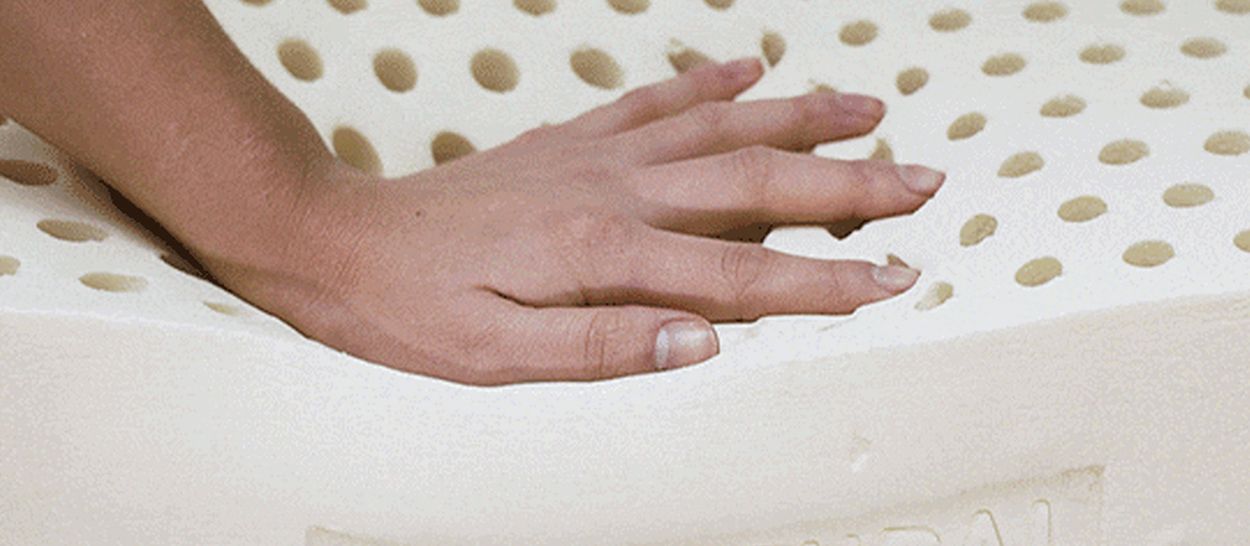
Natural latex is often described as having a honeycomb structure: it allows air to circulate better than a more closed structure. And this air circulation helps wick away some of the moisture that builds up overnight. Moisture, however, is a factor that makes bedding more conducive to dust mites.
The logic is simple: the more breathable a mattress is, the more the sleeping environment tends to remain “dry” and stable. This doesn’t eliminate dust mites (they’re found in homes), but it can limit the conditions that encourage their proliferation.
3) Natural or synthetic: a distinction that matters
A mattress marketed as “latex” is not necessarily made of 100% natural latex. It may be made of synthetic latex, derived from petrochemicals, or a blend. In such cases, the material does not behave exactly the same way, nor is it manufactured in the same way. For people with allergies who are looking for healthy bedding, transparency about the composition becomes an important factor.
If you'd like to understand how a natural latex mattress is constructed (core, cover, finishing touches, role of the layers), this guide can serve as a helpful supplement:
“What if I’m allergic to latex?” A valid question
We need to distinguish between two things:
being allergic to dust mites (very common),
being allergic to latex (less common, and varies greatly depending on individual profiles).
Latex allergies are generally discussed in the context of direct contact (gloves, certain types of equipment). In a mattress, the latex is found in the core of the product, and what comes into contact with the skin night after night is the cover, the sheet, any mattress protector, and the pillow.
In other words: the cover is an essential barrier. It’s just as important as the mattress core, especially when it comes to allergies and allergens.
If you have a severe, diagnosed latex allergy, the most responsible course of action is simple: seek the advice of a healthcare professional, and don’t try to figure it out on your own.
The duvet cover: the other half of the equation for healthy bedding

We often focus on the core of the mattress, when in fact the cover is the part that comes into direct contact with the body: it is the cover that absorbs sweat, collects dust, and endures friction, and it plays a key role in determining how breathable the mattress feels.
When it comes to choosing healthy bedding for people with allergies, three criteria are particularly important:
Breathability: a cover that does not trap excessive moisture.
Care: Ideally, the cover should be removable and washable according to the manufacturer's instructions.
Material consistency: A cover made of a highly synthetic, non-breathable material may negate the benefits of a naturally ventilated core.
In this regard, the logic is the same as for everything else: avoid the unnecessary, prioritize items that last a long time, and keep the bedroom easy to maintain.
And to maintain consistency even in the things that matter most to you, you can choose duvet covers made from breathable, easy-care materials.
Natural latex, foam, springs: what changes when it comes to allergies
There is no such thing as a “best” mattress for everyone. But certain choices make more sense when you’re looking for a hypoallergenic latex mattress or a mattress that repels dust mites.
A foam mattress (often made of polyurethane) can be comfortable, but its breathability depends largely on the technology and density used. Some foams trap more heat and moisture, which can make it difficult to maintain a comfortable sleeping environment.
Latex mattresses (when the latex is truly natural and well-ventilated) are often sought after for their balance of support, resilience, and breathability.
In any case, a mattress never works on its own. It rests on a box spring. And if you want to minimize trapped moisture, the choice of box spring is crucial.
The box spring: the detail that changes the airflow under the mattress

A slatted bed frame promotes air circulation under the mattress, leading to better moisture management on a daily basis. Conversely, placing a mattress directly on the floor—or on a poorly ventilated surface—can cause moisture to become trapped. And what we’re looking for, specifically, is an environment that’s less conducive to dust mites.
If you'd like to learn more about this topic, this guide is helpful: Which bed frame should you choose for a natural latex mattress?
Three Simple Tips for More “Dust Mite-Resistant” Bedding—Without Getting Obsessed
Even an excellent mattress is no substitute for basic hygiene practices. The goal is not to become obsessive about hygiene, but to maintain a clear routine.
Air out the room for 10 to 15 minutes every morning: this allows the moisture that built up overnight to escape.
Moderate temperature: A room that is too hot promotes humidity and a feeling of confinement.
Breathable linens and regular care: sheets and pillowcases are the first point of contact.
These steps help achieve the desired effect of a natural anti-dust mite mattress: less moisture, less stagnation, and fewer conditions conducive to proliferation.
Key Takeaways
For someone with a dust mite allergy, a natural latex mattress can be a sensible choice: it promotes better ventilation, helps reduce trapped moisture, and is often part of a healthy sleep environment when used with a box spring.
But the material isn't everything. The cover, maintenance, bedding, and airing out the room are all part of the same balance. It doesn't take much: just a few good choices and simple habits that last.