

There is a wide variety of mattresses on the market. To help consumers make the right choice, every online store offers a mattress buying guide. Like mattresses, comforters are also very popular, and there are several types available.
However, the various models of this bedding item each have their own advantages over the others, whether in terms of comfort, durability, or protection. It is therefore important to choose your comforter carefully to ensure optimal protection and comfort. Here are the most important criteria to consider when selecting a comforter that meets your body’s needs.

What type of duvet filling should you choose?
There are two main categories of filling: natural fillings and synthetic fillings. While these two types of filling are nearly identical in terms of thermal comfort, there are still several differences between them.
Duvets with Natural Fillings
Natural comforters are known for providing a soft, warm, and very plush feel. This type of filling allows for good airflow and is suitable for people who tend to sweat at night. It is made from goose or duck down and feathers. Before making a purchase, you should check whether the product complies with the standards applicable to bedding accessories.
If you're looking for a light, fluffy comforter, it's best to choose one with a down content of about 70 to 90 percent. Comforters with a high feather content, on the other hand, are heavier and can make you sweat more. They can also feel uncomfortable if they're too bulky.
Although goose-down comforters are the most popular on the market, those made from eider duck down are the best of all. However, comforters made from this material are quite expensive. This, in fact, is something all natural comforters have in common. They also carry a risk of causing allergies.
Synthetic-fill comforters
For people prone to allergies, it’s best to choose a synthetic-fill comforter. There is a wide variety available, and the price is generally very affordable for everyone. Some fibers are carefully engineered to ensure good thermal comfort and air retention, making the comforter lightweight.
To make the texture of synthetic comforters more similar to that of natural ones, some manufacturers opt for siliconized fibers, as they slide more easily against one another. For consumers who prefer an eco-friendly product, there are lines of comforters filled with recycled polyester. Manufacturers offering these products pair them with covers made from eco-friendly materials or organic cotton. There are also models made from wool, bamboo, and silk.
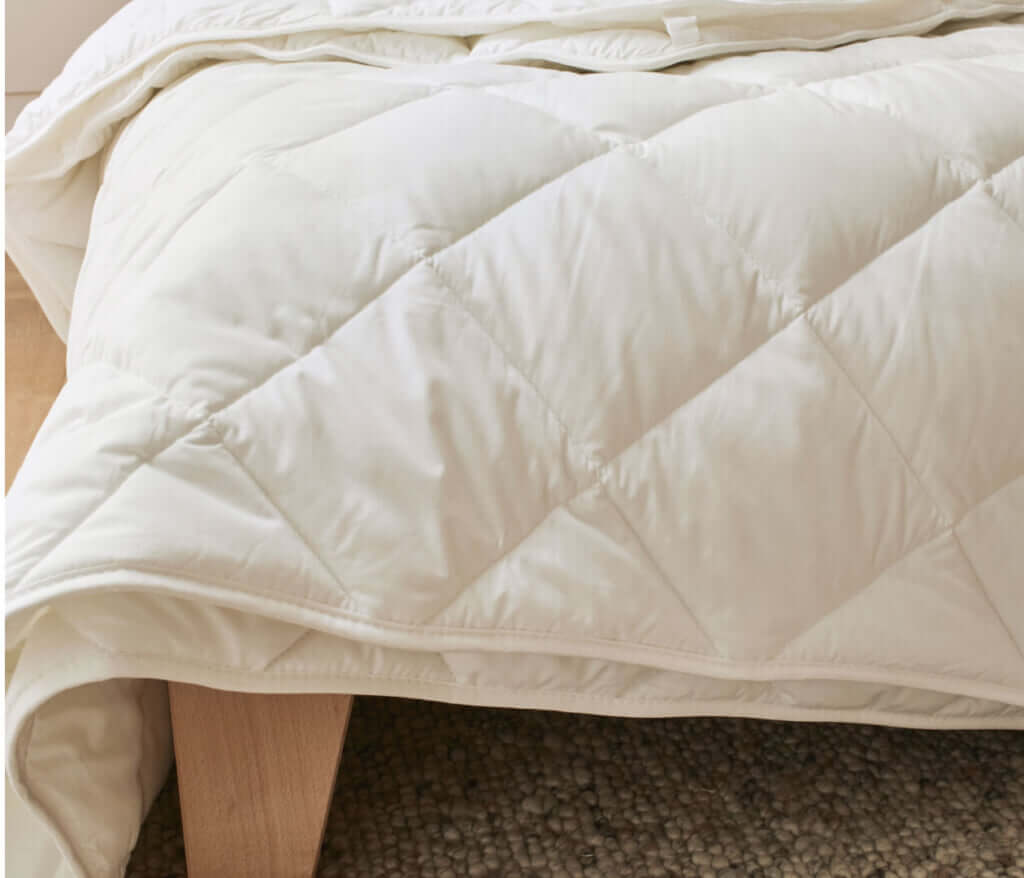
In addition, to help preserve the filling and prevent heat loss, synthetic comforters should be quilted in a box-stitch pattern. A grid-stitch pattern would be ideal for natural-fiber models.
What size adult comforter should you choose?
The purpose of a comforter is to keep the sleeper warm. To be effective, it must not allow any drafts to pass through. Therefore, when choosing a comforter, the main rule is that it should extend 20 to 40 cm beyond each side of the bed. To determine which size comforter to choose, you need to know the dimensions of the bed on which it will be used.
In addition to these factors, you should also consider the sleeper’s body type and movement patterns. The choice of duvet size also depends on the desired drape on each side of the bed.
A single-person comforter
The standard dimensions of a single bed are 90 x 190 cm. The ideal duvet size for this bed is 140 x 200 cm for a generous drape. For a bed that is 120 cm or 140 cm wide, the recommended duvet size for a single person is 200 x 200 cm. The drape on the first side will be quite generous, while on the second side it will be more modest.
The double comforter
To provide comfort for two people, a standard bed measures 140 x 190 cm. The recommended duvet size for two people is 240 x 220 cm with a generous overhang. When the bed width is 160 cm, the same duvet size is used, but the overhang will be smaller. For King and Super King beds, the ideal duvet dimensions are 260 x 240 cm.
How do you choose a comforter for a child?
Sleep is important for young children because it promotes healthy growth. Most of the factors to consider when choosing a comforter for an adult also apply when selecting one for a child. However, there are a few specific aspects that deserve special attention.
The weight of a children's comforter
A child's comforter should be light enough for the child to push it away if they feel suffocated. However, it shouldn't be too light, as it may not provide adequate protection from the cold.
The size of a children's comforter
As for size, the comforter should extend at least 20 cm beyond the edges of the bed. So, for a 60 x 120 cm bed, choose a comforter that is at least 80 x 120 cm or no more than 110 x 125 cm. If your child moves around a lot while sleeping, they’ll need a larger comforter.
The fabric of the children's comforter
When choosing the material for a children's comforter, opt for natural materials to ensure better breathability. A natural comforter provides good warmth, but it's important to note that it tends to be quite expensive.
For a more affordable option, choose a synthetic comforter, which is easy to care for. It’s ideal for children who wet the bed. It provides impressive warmth, even though it doesn’t breathe very well.
What to Consider When Choosing a Baby Duvet
Babies typically sleep between 17 and 22 hours a day. They spend more time under the comforter than any adult, which is why it’s important to provide them with a better one. To that end, when choosing a comforter for a baby, it’s essential to prioritize the quality of the material. It must be hypoallergenic to protect the baby’s health. In addition, when making a purchase, it is essential to choose a product that meets safety requirements.
It should be noted, however, that 25% of unexpected infant deaths are caused by the use of a comforter. As a result, doctors prohibit the use of comforters for babies and recommend sleep sacks or swaddles.
Which comforter is best for which season?
The choice of comforter should also be based on the season or on various temperature fluctuations. You should therefore consider the warmth rating or the weight per square meter of the comforter. The weight per square meter indicates the amount of filling per square meter.
The Summer Duvet
When choosing a summer comforter, opt for one with a warmth rating of 1 to 2. In fact, during this season, the temperature in the bedroom typically reaches 22 °C. Therefore, there’s no need to invest in a very warm comforter. A lightweight, moderate-weight comforter with a weight of 175 g/m² should do the trick.
The Winter Comforter
Unlike in the summer, when choosing a winter comforter, you should opt for a warm model with a warmth rating of 2 to 4. If the heat is on and the indoor temperature is 18 °C, the ideal weight should be 300 to 350 g/m².
However, for temperatures below 18 °C, a very warm comforter with a warmth rating of 5 to 6 is recommended. Its weight is therefore 400 to 500 g/m².
The 4-Season Duvet
To keep costs down, you might wonder whether to choose a four-season comforter instead of a separate comforter for each season. In reality, this type of comforter is recommended for bedrooms where temperature fluctuations are minimal.
A four-season comforter typically consists of two layers: a lightweight one (175 to 200 g/m²) and a warm one (320 g/m²). The first is designed for summer, and the second for temperate weather. For winter nights, the two layers should be combined for better warmth.
How should I care for my comforter?
The final factor to consider when buying a comforter is how to care for it. Comforters are known to become quite heavy when wet, which makes hand-washing virtually impossible. However, some models cannot be machine-washed. You should therefore consider how to wash the comforter after a few months of use.
To avoid the hassle of washing, it’s best to choose machine-washable models. Washing at 60 °C helps eliminate any dust mites that may be present in the bedding. Just check the product label for this information when you buy it.
Ultimately, choosing a comforter depends as much on the type of filling as on the season in which it will be used and your personal needs.
We recommend these other pages: