


Every year, approximately 18 million metric tons of cotton are grown. Only 0.7% of this cotton is organic. Large-scale cultivation has significant environmental impacts. The term “organic” sounds reassuring and more eco-friendly, but what’s the difference between the two types of cotton? What does it actually mean to choose products made from organic cotton? How does organic cotton differ from conventional cotton? Organic is good, but why? We’ll tell you!
The cultivation of conventional cotton
Cotton comes from the cotton plant and is harvested using large harvesting machines. The world’s leading cotton producers are: India, followed by China and the United States. Organic cotton is mainly used in the textile industry, which is worth 37 billion dollars a year. However, the cultivation of conventional cotton is not very sustainable.
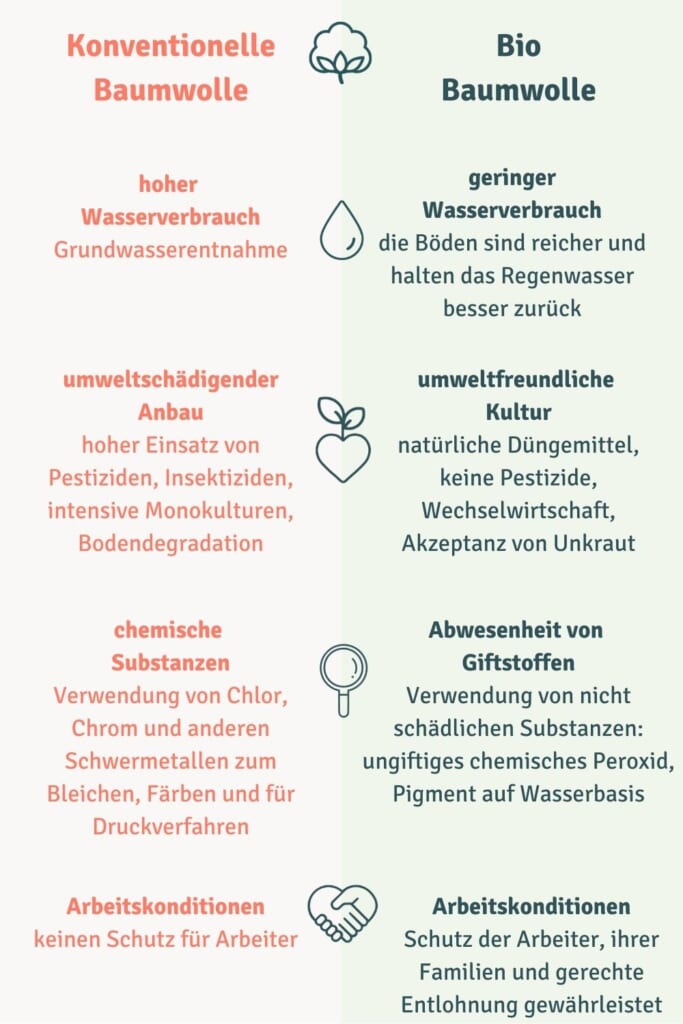
Conventionally grown cotton has a negative impact on the planet, not to mention the economic and social consequences. Conventional cotton farming involves the use of pesticides, some of which are classified by the WHO as particularly hazardous.
Furthermore, conventional cotton production is very water-intensive: 5,260 liters* are needed to produce one kilogram of cotton. To give you an idea: It takes 7,500 liters of water to make a pair of cotton jeans (that’s 50 full bathtubs).
Heavy metals such as lead and chromium are used to dye cotton. To use the same example as with jeans: 1 kg of pigment is used for dyeing, along with a few hundred kilograms of oil and solvents, and 1,000 liters of water.
In addition, intensive farming practices—such as monocultures—lead to soil depletion. Organic cotton, on the other hand, is a greener alternative that promotes more sustainable agriculture.
Organic Cotton: A Solution for More Sustainable Production
There are several key differences between the cultivation of conventional and organic cotton.
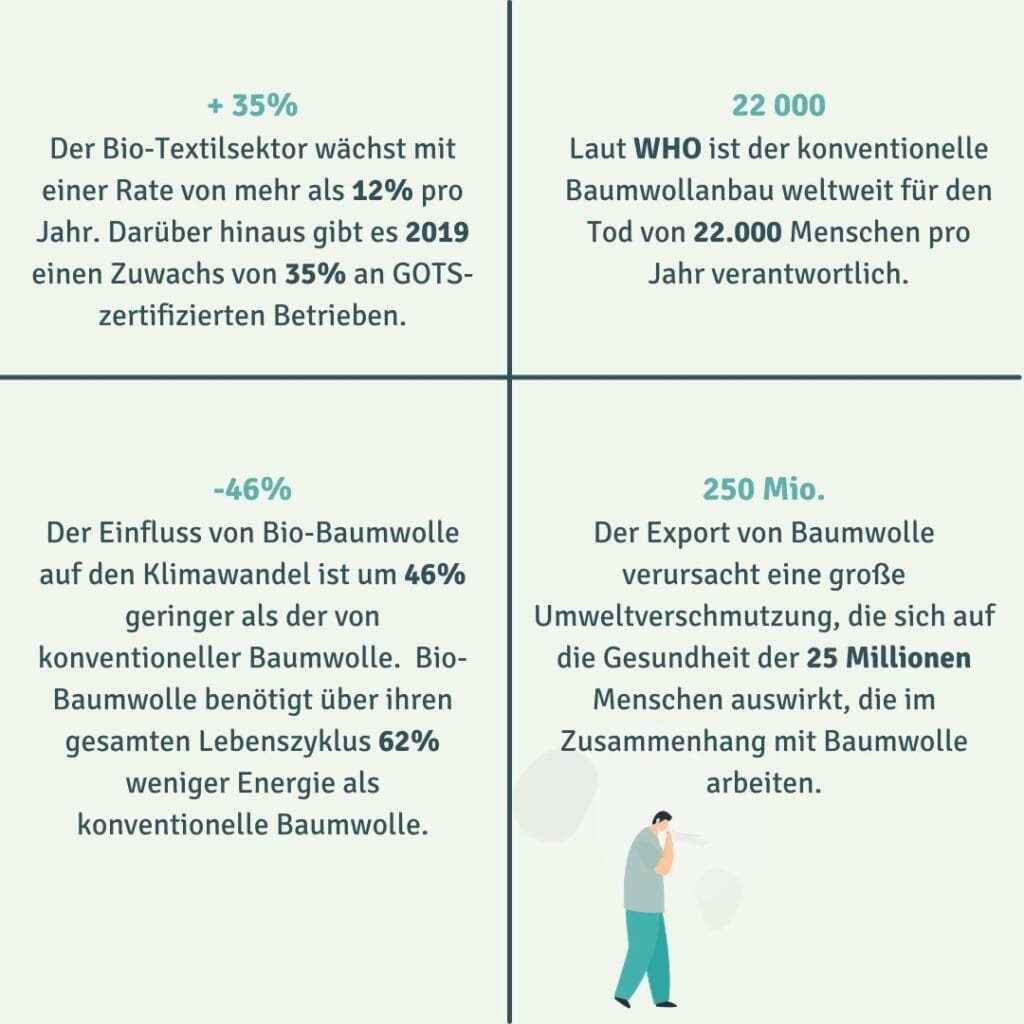
Here are a few figures that speak for themselves…
Effects on Water: Use Sources with Caution
1 T-shirt = 70 showers, 1 pair of jeans = 50 baths: When you consider that India and China are the leading cotton producers—and also two countries that face serious problems with access to fresh water—it’s time to take a critical look at the situation.
Several figures have been presented to compare the differences in water consumption between conventional and organic cotton. However, it is not quite so simple to provide an exact figure for the savings achieved, as this depends on the comparison method and the types of crops being compared.
The most frequently cited reference comes from the Textile Exchange report "The Life Cycle of Organic Cotton Fiber" from 2014. It shows that growing organic cotton uses 91% less water than growing conventional cotton.
What's the problem?
There are some inaccuracies in the climate data. This is because, from one country to another and from one geographic region to another, factors such as soil permeability and precipitation levels can vary greatly. The data on irrigation rates for the same areas are not specified precisely.
However, given that we know rainwater is rarely sufficient to irrigate fields and that water must be diverted from rivers, lakes, and aquifers, we also know that this cannot be sustainable.
Another problem
Growing organic cotton also requires a lot of water. However, water consumption is lower than with conventional cotton. The soil used for organic cotton contains more organic matter and can store more water. Furthermore, rainwater is often collected and used for irrigation on organic farms. A 2014 study found that water consumption in organic cotton production is 91 percent lower than in conventional cotton production.
Organic cotton isn't always snow-white
We often imagine cotton as pristine white. However, it is only snow-white because it is often bleached with dyes. In reality, cotton in its natural, unbleached state tends to be more of a beige color. Products made from organic cotton—such as the Kipli mattress cover—are not bright white. This is because we deliberately avoid using bleaches, thereby preventing the unnecessary use of chemicals.
In rare cases, you may also notice a tiny brownish speck on your mattress cover. When organic cotton blooms, the seed pods burst open, releasing a white seed. This is when the cotton is harvested. It is compressed into a large bale using a baler, and then the cotton fibers are separated from the seed pods and seeds in a ginning machine. However, in unbleached fabrics, the seed pod remnants may remain visible as black dots.
Don't panic—these are just spots caused by the nature of the cotton. It's simply nature's way of doing things and a sign that no chemicals were used.
Beware of Greenwashing
If you see "Sustainable Cotton" on a product label, the cotton used is not necessarily organic. Similarly, some labels are misleading, as ADEME notes. This is particularly true of the BCI label, which was introduced relatively recently and is very easy to obtain—but that does not mean the cotton is organic.
How can you tell if your bedding is really made of organic cotton?
GOTS and OCS: The Essential Certifications for Organic Cotton
The Global Organic Textile Standard (GOTS) is the world's leading processing standard for organic textiles. GOTS guarantees that the cotton in a product is organically grown.
The Organic Content Standard (OCS) provides independent assurance that the organic content of textiles can be traced back to the source.
Conclusion
Less water consumption, fewer health problems, more environmentally friendly, more sustainable… Organic cotton is more sustainable than conventional cotton. But organic cotton is still cotton—and therefore a water-intensive crop. So, to reduce the use of this precious natural resource, you should keep a few common-sense rules in mind. We need to try to change our consumption habits and buy fewer products—but instead choose higher-quality products with trusted certifications.
If you still have any questions, please feel free to contact us via chat, by email at kontakt@kipli.com, or by phone at +49 (0) 32 21 22 96 570.