

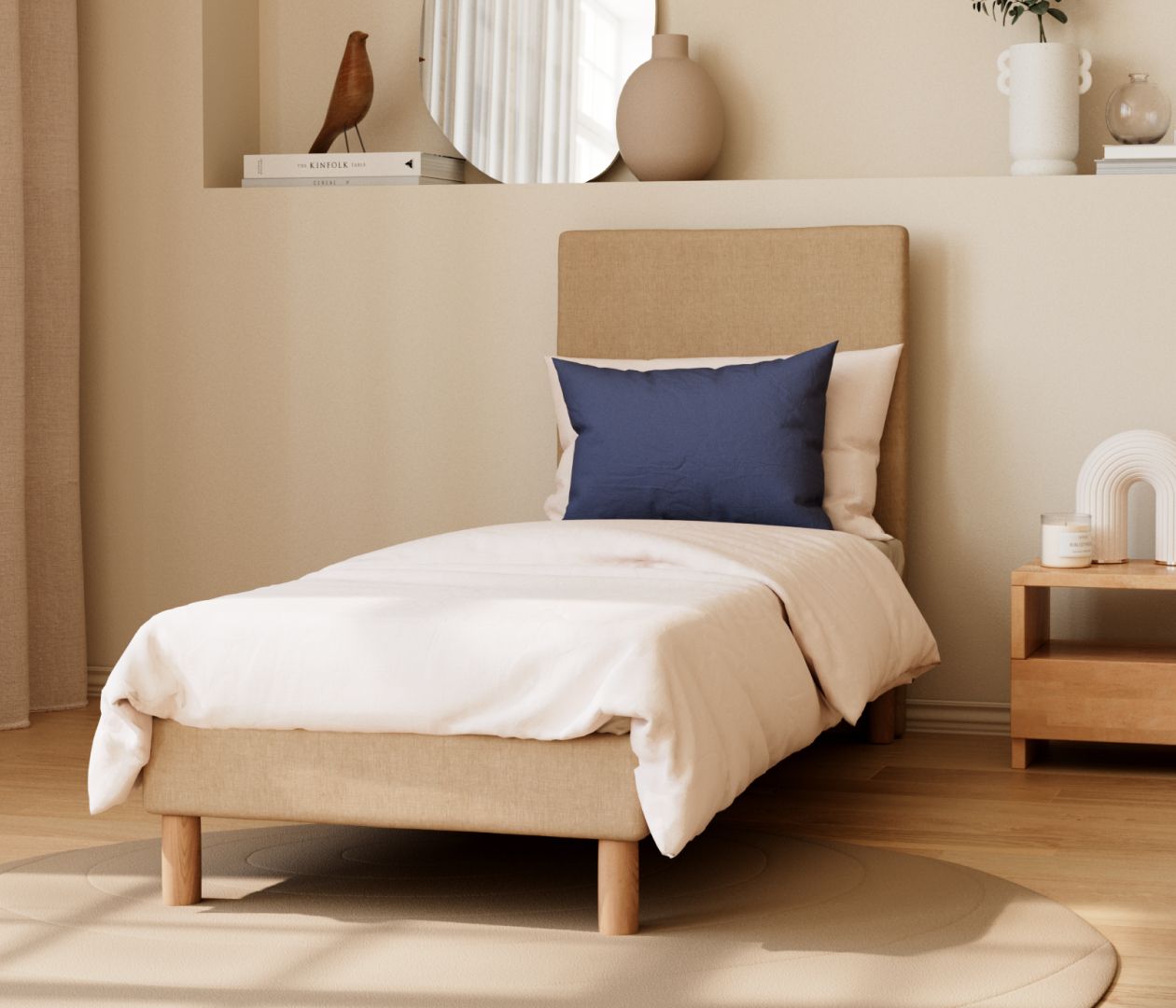
A child’s bedding is essential for their healthy growth, even though it’s not always easy to know how to choose the right products. Among these items is, of course, the mattress—a piece of furniture where quality is essential, since a child will most likely spend more than 8 hours on it every night. Indeed, the model you choose must meet your child’s needs and accommodate their growth, even if that means understanding the characteristics and features of the different types of mattresses available on the market.
Of all the important factors, the one related to mattress thickness remains a complex issue to resolve. It’s important to note that this depends on several factors, such as the child’s weight, the mattress’s composition, and the model’s density.
To help you make a more informed decision, let's take a look at the key tips you need to know when choosing the thickness of a children's mattress.

The Importance of Mattress Thickness for a Child
Just as with adults, the mattress plays a significant role in your child’s health and development. This starts with choosing the right thickness, since some mattress models aren’t suitable for all ages. Before we dive deeper into the criteria you need to know to make the right choice, let’s quickly look at why your child’s bedding is just as important to you as it is to them.
A mattress is an ally in growth
Your child’s healthy growth is obviously a priority for you as a parent. Whether through food or even sports, there are many ways to support your child’s development. However, one of the most important factors is, of course, the equipment you provide for them, starting with their bed and related items.
It is important to understand that your child’s mattress can have a significant impact on their body structure, for example, by causing painful pressure points or back pain. Furthermore, a good night’s sleep is essential for your child’s academic success, as it promotes physical and mental recovery.
The mattress should be tailored to your specific sleep needs
Unlike adults, children’s sleep has many unique characteristics, starting with longer periods of deep slow-wave sleep. It is precisely during this stage thatgrowth hormone is secreted by your child’s body, which means that your child goes through these different sleep stages throughout the night. For this reason, it is obviously necessary to buy a high-quality mattress that is thick enough for your child’s weight and height.
To give yourself the best possible chance, you should look for resilient models designed to accommodate your child’s movements and adapt to their body type. In this regard, options include high-density polyurethane foam mattresses and latex mattresses, both of which are known for providing the right support for your child.
It's important to note that the choice of bed frame is also important, since it must be compatible with the mattress you choose.
Choosing the Thickness of a Children's Mattress: Materials
When it comes to children's mattresses, there are three main types:
- foam mattresses (low-density, memory foam, and polyurethane);
- the spring mattress;
- the natural-fiber mattress.
Each of these three scenarios obviously has its pros and cons, but also—and most importantly—constraints in terms of thickness and density. As for low-density foam mattresses, they are traditionally considered to be of lower quality, whether for adults or children. No matter your child’s age, the density of this mattress never exceeds 25kg/m³, making it a poor choice for your child’s growth and spinal health. Note that memory foam mattresses should also be avoided, as they do not provide sufficient support for the body during this critical stage of development. When it comes to foam, it’s best to choose polyurethane, provided you opt for a density between 30 and 40kg/m³. Most often, mattresses of this type range in thickness from 16 to 20 cm.
As for the standard spring mattress, it is strongly discouraged, even if it is marketed as a children’s model. The same applies to the pocket-spring mattress, which, although it can serve as an occasional sleeping surface for a toddler, has some drawbacks for children under a certain age—starting with the noise it often produces.
Finally, a mattress made of natural fibers—particularly natural latex—is an excellent choice when buying a children’s mattress. Some models are even made from wool, coconut fibers, bamboo, or cotton. In any case, this is a very healthy option for your child, provided you pay close attention—once again— to the density and thickness of the model you choose. For this type of mattress, a thinner profile may be acceptable, as evidenced by high-quality models around 15 cm thick, especially if the listed density is 35kg/m³ or higher.
Choosing the Right Thickness for a Children's Mattress: Weight
It goes without saying that, depending on your child’s age, the thickness of their mattress may vary. This factor is primarily determined by your child’s weight, since their needs are not necessarily the same depending on their growth and current developmental stage. In this regard, it is important to distinguish between various key stages in their development, which are as follows:
- the phase of less than 30 kg;
- the 30- to 50-kg phase;
- the 50- to 80-kg phase.
In the case of a child or young teenager, the main stages of development are, of course, limited to the first two mentioned above. However, in rarer cases, a young teenager may be significantly overweight and exceed 50 kg.
For a weight of less than 30 kg
If your child weighs less than 30 kg, the density of their new mattress should be between 25 and 40kg/m³. In terms of thickness, this generally means a mattress between 16 and 20 cm thick.
For a weight between 30 and 50 kg
As your child begins to grow, their sleep needs increase, which means you’ll need to choose a mattress with the appropriate density. For children weighing between 30 and 50 kg, it’s generally recommended that the density be at least 35kg/m³, which typically corresponds to a thickness of 18 to 20 cm.
For people weighing between 50 and 80 kg
For teenagers weighing more than 50 kg, a firmer mattress is needed, which is why it’s important to choose one with a density of at least 40kg/m³. Once again, the thickness of these mattresses ranges from 16 to 20 cm.
We recommend these other pages: