

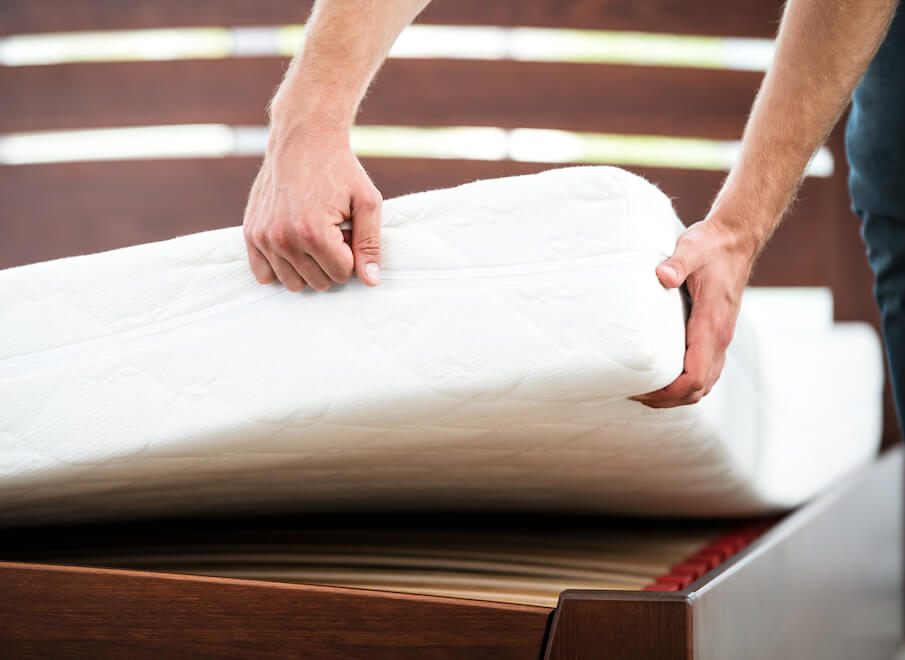
Learn more about mattress thickness in this article...
The Different Thicknesses of Mattresses
A - Mattresses that are 15 cm or less in height
Mattresses that are 15 cm thick or less are primarily intended for children. Children can achieve optimal comfort with a mattress of this thickness because they do not have the same needs; a child can get excellent support from a mattress that is 15 cm or less thick. However, this type of mattress should not be used by adults, as there is a risk that the support will be insufficient, which could lead to back pain.
B - Height between 15 and 20 cm
Mattresses between 15 and 20 cm thick are generally considered the most common type.There are different types of mattresses: memoryfoam, latex, etc. However, it’s important to remember that thickness isn’t always a sign of quality. Thicker mattresses can actually be of poor quality.
C - Between 20 and 25 cm
D - Mattresses thicker than 25 cm
Criteria to Consider
A - Age
B - Materials
What thickness should you choose for a latex mattress?
For some materials, such as natural latex, a thick mattress is guarantee of great comfort. Latex mattresses are suitable for all ages and body types. We recommend a core of at least 18 cm for optimal comfort. At Kipli, for example, we’ve chosen a 20-cm core (15 cm + 5 cm) for our natural latex mattress (22 cm total thickness with cover). For the Kipli baby mattress model, the core is 10 cm.Mattresses of this thickness have a long lifespan (15 years for natural latex mattresses, 10 years for synthetic latex mattresses).
Latex mattresses are always a good choice. Click the link below to purchase your own natural latex mattress and learn more about its features: Kipli Natural Mattress.
How thick should a memory foam mattress be?
For memory foam mattresses, it is advisable to choose mattresses with a minimum thickness of 18 cm. These synthetic foams are typically combined with polyurethane (or high-resilience foam) in multiple layers. However, even a thick layer of these foams does not guarantee a long service life, as they tend to deteriorate more quickly. The service life is often limited to 7 years.Pocket-Spring Mattresses
Spring mattresses They are usually quite thick: They are typically more than 20 cm thick. They offer good breathability. For greater independence between sleeping surfaces, it is preferable to use pocket springs.The springs have a fairly long lifespan. However, the lifespan of these mattresses also depends on the foam used in combination with the springs on the mattress surface. In most cases, this foam is synthetic and therefore has a limited lifespan (about 10 years). Unlike synthetic latex, the lifespan of a spring mattress is about 12 years.
Other factors to consider when buying a mattress
A - Density
As explained earlier, The density of a mattress is important because it is the indicator used to measure firmness. This should be the same for a child as for an adult, and for a smaller person as for a stronger one. It is the scale that determines the mattress’s density level, ranging from softest to firmest. You need to be careful when choosing your mattress material, since density values can vary. Therefore, a higher density does not always guarantee greater firmness.For example, polyurethane foam with a density of 30 kg/m³ may be firmer than natural latex with a density of 70 kg/m³. Polyurethane foam is, by definition, a firm foam because the cells that make up the foam make it less airy. This is why a polyurethane foam mattress can be considered firm even with a density of only 50 kg/m³. For this type of foam, density is a measure of the mattress’s lifespan. In fact, the denser a polyurethane foam mattress is, the slower it will sag. As you can see, when discussing density, it’s important to consider the mattress composition.
Next, we'll explain how to choose The Best Density for a Latex Mattress. For those who prefer a high level of support, a high-density mattress is recommended. Keep in mind that a natural latex mattress can have a density of up to 90–95 kg/m³. A density of 65 kg/m³ will provide a soft firmness, 75 kg/m³ a medium firmness, and 85 kg/m³ or more will provide greater firmness.
To ensure good support, also You should choose the density of your mattress based on your weight. If you sleep with your partner, you should also take their weight into account. Here's more information on how to choose a mattress based on your partner's weight.
B - Size
In addition to thickness, you should also consider the person's size when choosing the right mattress. The standard size for a single bed is 90x190, and 135x190 or 160x200 for a double bed. However, we recommend that you choose a mattress that is 10 or 15 cm longer than your height to keep your feet from sticking out of the bed.When it comes to children, you should avoid focusing on their age when choosing a mattress. In fact, you should take their size and growth rate into account so you don't have to replace the mattress too often.
As for width, the wider the mattress, the more comfortable you'll feel, especially if you sleep together. However, you have to Take the size of the bedroom into account so that the bed doesn't look out of proportion.
C - Box Spring
When you buy your bed, don't forget to choose your box spring carefully. It affects the firmness of your mattress by up to 40%. Choose soft slats for a soft feel and firm slats for firmer support. It's important to choose the right box spring to sleep well.
D - Sleeping Position
Sleeping on your stomach is the least recommended position. In this position, the spine and neck are not aligned and are not properly supported. If you sleep in this position, you should avoid sleeping on mattresses that are too soft.When sleeping on your side, certain parts of the body—such as the shoulders, hips, and neck—require different levels of support. Therefore, It is advisable to use mattresses with support zones For greater comfort, there are mattresses that are a little softer.
When sleeping on your back, your weight is distributed evenly; in this position, your back is the area that needs the most support. Most mattresses provide adequate support for this area, so choosing one shouldn't be difficult. Our advice is to choose a mattress that is neither too firm nor too soft.
After reading this article, mattress thickness is no longer a mystery.
We hope this information helps you choose the best mattress for you.
If you have any questions, please feel free to contact us via chat, by email at contacto@kipli.com, or by phone at +34 919 010 175
Of course,
the Kipli team.