


At night, everything looks simple. Two rectangles, two mattresses, a white cover, a comforter on top. But beneath the fabric, the stories are very different: on one hand, petrochemical-based foams; on the other, a plant-based material that breathes and stands the test of time. From a distance, everything looks the same. Up close, the choice of mattress says a lot about how we sleep… and how we consume.
Same shape, two approaches to sleep
In the store, the mattresses are perfectly aligned, well-lit, and covered in light-colored fabric. You sit down, lie down for a few seconds, and bounce a little. The scene is always the same, but the story that follows will not be.
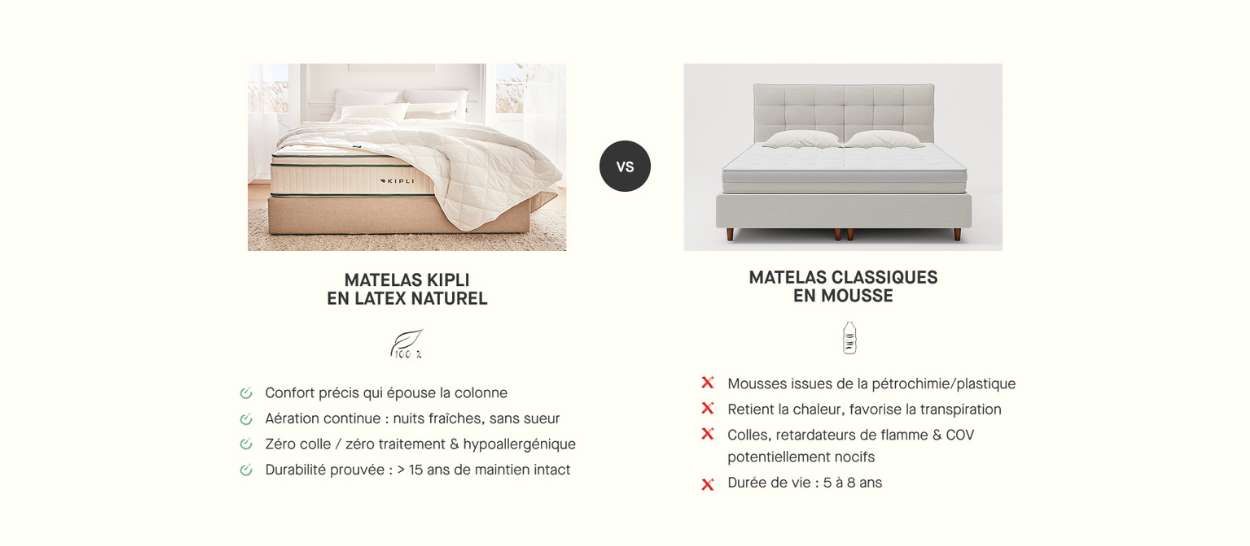
Behind the same appearance, two worlds coexist: that oftraditional mattresses, often made primarily of synthetic foams and petrochemical-based materials, and that ofnatural latex mattresses, made from a plant-based material that is elastic and durable. One promises immediate comfort, often at a bargain price. The other focuses on the consistency of its materials, stable support, and longevity.
Classic Mattresses: What You Don't Always See
Beneath a cover that feels pleasant to the touch, the “classic” mattress usually contains a combination of polyurethane foam, memory foam, or pocket springs surrounded by synthetic layers. At first, the sensation can be very enveloping: you sink in, you feel as if you’re floating, and the promise seems to be fulfilled.
Then, over the years, another reality sets in: a slight dip in the center, areas that sag, heat that builds up under the comforter, and waking up sometimes feeling clammy or as if you’ve “slept in a hole.” Many traditional mattresses need to be replaced after 6 to 8 years—sometimes sooner—because they no longer provide the same support, and the body eventually starts to protest.
It’s rarely dramatic: no noise, no breakage. Just a series of small things, night after night, that signal the mattress has reached its limits. We add a mattress topper, flip the mattress over, and “make do.” Until the next purchase, and the cycle begins again.
Natural Latex Mattresses: A Different Approach to Comfort
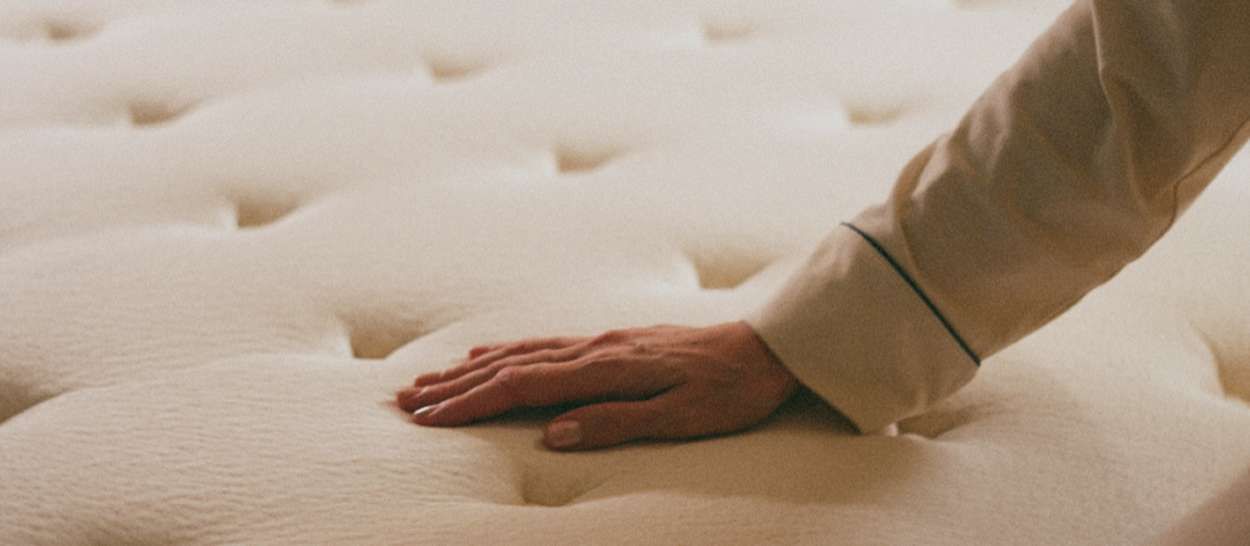
A natural latex mattress is a different story. Its core is made from the sap of the rubber tree, a plant-based material that is naturally elastic and resilient. At Kipli, this commitment is reflected in several models, all designed without synthetic foam or added chemical treatments.
While many traditional mattresses focus on providing exceptional comfort during the first few months, these natural latex mattresses—with or without springs—take a different approach:comfort that lasts. It’s the kind of comfort you don’t notice every night, but you realize when you wake up: less pain, deeper sleep, and a mattress that doesn’t become a headache after a few years.
Health & Indoor Air Quality: What's in the Air in the Bedroom?

The bedroom is the room where we spend the most time, without really realizing it. What we put in this room matters: the linens, the paint, the furniture… and, of course, the mattress.
A traditional mattress made of synthetic foams may, depending on its design, contain various types of adhesives, anti-dust mite treatments, and flame retardants to compensate for the poor breathability of certain materials or to meet strict standards. The result is often a complex composition that is difficult to understand, with layers stacked on top of one another.
Natural latex works the other way around. Theplant-based latex used by Kiplihasnaturalanti-mite and antibacterial properties, whicheliminates the need for many added chemical treatments.The organic cotton coversarebreathable, removable, and easy to clean.
In the bedroom, this translates toa more neutral, less saturated atmosphereandthe feeling that the bed doesn’t add an invisible layer of complexity. Nothing spectacular at first glance, but true, unobtrusive comfort for the body, the skin, and breathing.
Durability: What Happens After 10 Years
When you buy a mattress, you rarely think about its “last day.” Yet that’s also where the difference between a natural latex mattress and a conventional mattress lies: in how it ages and how well (or poorly) it holds up after several thousand nights.
A standard mattress that needs to be replaced every 6 or 7 years means another delivery, more packaging, an old mattress to dispose of, and the feeling of having to go through the same search for comfort all over again at regular intervals. It also means a recurring expense—sometimes more often than expected.
Natural latex, on the other hand, is known for itsresistance to sagging. Its cellular structure and elasticity allow it to return to its original shape after every movement. With tests such as LGA certification (less than 1% loss of height after 30,000 movements), this is no longer just a theoretical claim, but a performance measured over time.
If you look at the cost over 10 or 15 years, the initial price difference between a natural latex mattress and a synthetic mattress becomes less significant: a mattress that lasts twice as long means fewer purchases, less hassle, less waste, and comfort that doesn’t fade halfway through its lifespan.
Nighttime Comfort: When the Body Decides

When it’s time to go to bed, the body doesn’t analyze the mattress’s composition—it feels it. It senses whether the shoulders sink in evenly, whether the pelvis “plunges” downward, whether the spine remains aligned, and whether each of the partner’s movements causes the mattress to vibrate.
Kipli natural latex mattresses (Premium, Prestige, or Ultime) offer comfort zones , dual-sided designs, or combinations of latex and springs that allow you to adjust the feel without sacrificing support. The goal isn’t to surprise you during the first few nights, but to provide long-term support for your body.
The “drama” often unfolds upon waking: either you get up feeling well-rested, or with the sensation that you’ve aged a few years overnight. A mattress that’s too soft or too hard forces the body into compensatory positions, whereas natural latex seeks to conform to and support the body, rather than constrain it.
How should we decide what happens next in the story?
We could summarize it simply as follows:
Atraditional mattress oftenprioritizesshort-term benefits: an immediate, pronounced feel, an attractive introductory price, a less transparent composition, and a generally shorter lifespan.
Anatural latex mattress—whethermadeof 100% latex or combined with pocket springs—emphasizes consistency: plant-based materials, a well-engineered design, long-lasting support, and a mattress that breathes better.
The right choice then depends on your priorities: a mattress that will “last a few years,” or a long-term companion that’s healthier for you and more environmentally friendly. At Kipli, we’ve chosen our side: sustainable, simple sleep—without unnecessary frills.
Kipli, plain and simple.