

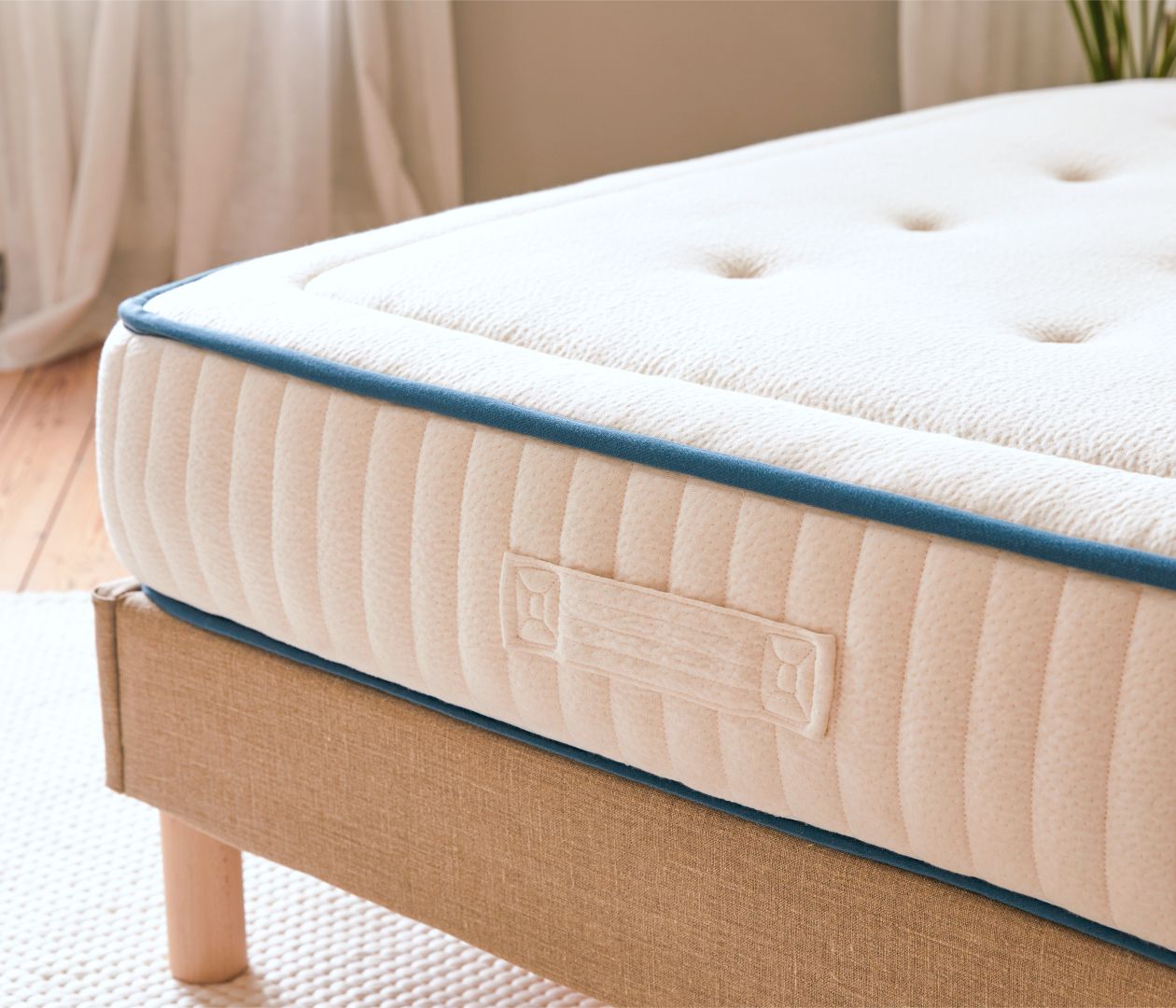
Whether it's memory foam mattresses, innerspring mattresses, bamboo mattresses, or natural latex mattresses, there is a full range of synthetic and natural mattresses available at every price point. Better for your health and better for the environment, natural mattresses are increasingly sought after by consumers.
Mais comment faire pour choisir son matelas ? Quels éléments faut-il prendre en compte pour être certain d'acheter un vrai lit bio ? Tous les matelas naturels sont-ils des matelas durables et écologiques ? Quel type de matelas offre un meilleur confort de sommeil ? Nous vous proposons de découvrir tous nos conseils pour bien choisir votre matelas naturel.

Overview and Definition of the Green Mattress
Foam mattresses, spring mattresses, or latex mattresses: which one qualifies as a “green” mattress? To answer this question, we’ll take a look at the list of different materials used to make mattresses. We’ll also examine the manufacturing methods so we can precisely define what a “green” mattress is.
Materials Used in Mattress Manufacturing
Not all mattresses are made from the same materials. In fact, the materials used in a mattress are key to determining whether it is eco-friendly or not. That is why we are beginning our overview of eco-friendly mattresses with a look at the different materials used in mattress manufacturing. This will help us understand what materials eco-friendly mattresses are made of.
Here are the main types of mattresses available on the market:
- polyurethane foam mattress;
- polyether foam mattress;
- memory foam mattress;
- pocket-spring mattress;
- natural latex mattress;
- synthetic latex mattress;
- organic cotton mattress;
- wool mattress;
- bamboo mattress;
- etc.
But among all these materials, only a few are used to make an eco-friendly mattress: natural latex, wool, and organic cotton. Tencel should also be added to this list; it is a breathable, durable fabric made from wood pulp.
In summary, a "green" mattress is one made from natural materials such as natural latex, Tencel, wool, or organic cotton.
Mattress Manufacturing Methods and Risks to Health and the Environment
In addition to the materials used to make a mattress, it is important to consider the manufacturing methods. These factors come into play when defining what constitutes a “green” mattress. For a mattress to be considered “green,” its manufacturing process must be natural and environmentally friendly.
A great many mattresses are made with materials that are toxic and harmful not only to human health but also to the environment:
- volatile organic compounds;
- treatments for mold or dust mites;
- isocyanates and phthalates;
- flame retardants;
- etc.
Sweating can increase the transfer of these chemicals into the body. This is especially dangerous for a baby, who needs more sleep than an adult. As a result, a baby is exposed to these hazardous substances for longer periods of time.
The green mattress is a durable and healthy mattress. This means it contains none of these toxic substances. On the contrary, it is made entirely of natural materials and therefore poses no risk to your baby's health.
The Bamboo Mattress: Its Natural Properties and Certifications
Parmi la gamme de matelas naturels, le matelas bambou s'impose parfois à l'esprit. En effet, la literie en bambou présente une liste intéressante de propriétés naturelles liées aux qualités intrinsèques de la plante.
List of the Main Benefits of Bamboo Bedding
Bamboo mattresses offer many benefits thanks to bamboo fiber. In fact, this plant has natural properties that are found in bamboo bedding. As such, a bamboo mattress is a natural mattress that is healthier than a memory foam mattress or a synthetic latex mattress.
Here is a non-exhaustive list of the benefits of a bamboo mattress:
- anti-mite;
- hypoallergenic;
- breathable;
- durable;
- mild;
- absorbent;
- farm.
Choosing a bamboo mattress means choosing comfort and peace of mind night after night. It also means giving your baby cool, dry nights.
OEKO-TEX certification to consider for the bamboo mattress
However, it is important to keep in mind that while a bamboo mattress is made from a natural plant, it is nonetheless a processed product. In order for bamboo that grows in the wild to be turned into a mattress, the fibers must undergo certain treatments. These treatments may be more or less beneficial to health and more or less environmentally friendly.
So, when buying a natural mattress, look for bamboo mattresses certified under the OEKO-TEX® STANDARD 100. This certification does not guarantee that the mattress is organic, but it does guarantee that it was manufactured using safe processes. Therefore, OEKO-TEX® STANDARD 100-certified bamboo bedding is guaranteed to be free of harmful substances.
Other factors to consider before buying an eco-friendly mattress
Once you’ve chosen the materials and manufacturing processes, there are still other factors to consider when selecting the right eco-friendly mattress. Comfort zones, price, and mattress density are among the criteria you shouldn’t overlook when purchasing an eco-friendly mattress.
The Importance of Comfort Zones in Organic Bedding
To choose the right natural mattress, it’s important to pay close attention to the mattress’s comfort zones. These comfort zones are designed to conform to the body. As a result, you’ll enjoy optimal sleep quality with a mattress that provides different levels of support for your back, head, legs, and so on.
Some brands offer mattresses with seven comfort zones on the firm side. This ensures ideal spinal support throughout the night. To enhance your sleep comfort, choose a suitable bed base. For example, a slatted bed base is ideal for a natural latex mattress because it is highly breathable.
Choosing the Density and Firmness of a Natural Mattress
The density of a natural mattress determines its firmness. The higher the density of the natural mattress, the firmer the sleeping surface will be. Depending on the material used to make the mattress, the density will vary. For example, a high-density foam mattress will not provide adequate support for people with back problems.
Similarly, the density of a natural mattress—made of natural latex, for example—must also be chosen based on body weight. Some natural mattress models are better suited for heavier individuals, while others are recommended for lighter individuals. Thus, a soft mattress is recommended for lighter individuals, while a firmer mattress is recommended for heavier individuals.
Factors That Can Affect the Price of Natural Mattresses
Finally, it’s important to consider the price of the model. In fact, the price of each type of bed varies depending on:
- density;
- the thickness;
- the filling;
- the subject;
- the manufacturing process;
- etc.
Similarly, lifespan is one of the factors that influence the price of a natural mattress. A line of mattresses with a five-year warranty will not be sold at the same price as a line of mattresses with a ten- or fifteen-year warranty.
Finally, when choosing from among all the natural mattress models, opt for those offered by brands that prioritize transparency, quality, and reliability. This way, you can be sure you’re purchasing a high-quality, durable, and eco-friendly organic mattress. You’ll also be guaranteed personalized and responsive customer service.
In summary, when choosing a natural mattress, find out the exact composition of the mattress and select the model that best suits your body type. Natural mattresses are not interchangeable products. On the contrary, they must be selected for a specific purpose.
We recommend these other pages:
- What size mattress should you choose?
- What factors should you consider when choosing the best mattress?
- How do you choose the firmness of a mattress?
- Which children's mattress should you choose?
- Which mattress brand should you choose?
- What size mattress should you choose?
- How to Choose an Organic Latex Mattress?
- Which baby mattress should you choose?